Dandelion
Dandelion: what it is, how it works, and what the evidence shows
A plain-English guide to dandelion root and leaf: how each is used, what the research supports, and who should be careful.
By Artifact Editors, Editorial team
Published · 6 min read
In this article
What dandelion is
Dandelion is Taraxacum officinale, the yellow-flowered weed that grows in lawns and sidewalk cracks. It is also a long-used herb, taken across Europe, Asia and the Americas mainly for digestion, appetite and liver and gallbladder support. That history is real, but it is a history of habit rather than controlled testing.
A 2006 pharmacology review described the traditional digestive and liver uses as resting on generations of use, not clinical trials [PMID 16950583]. More recent reviews, including a 2023 compilation of the plant's chemistry and pharmacology, reach a similar conclusion: most reported activity comes from laboratory and animal work [PMID 37446683].
That framing is the key to reading everything else about dandelion. It is a plausible, widely used botanical with a thin human evidence base. Our dandelion topic page collects the more specific questions.
Root, leaf and flower are not the same thing
Labels that say only "dandelion" are ambiguous. The three plant parts are used differently, and the studies behind them differ too.
| Part | How it is typically used | Research picture |
|---|---|---|
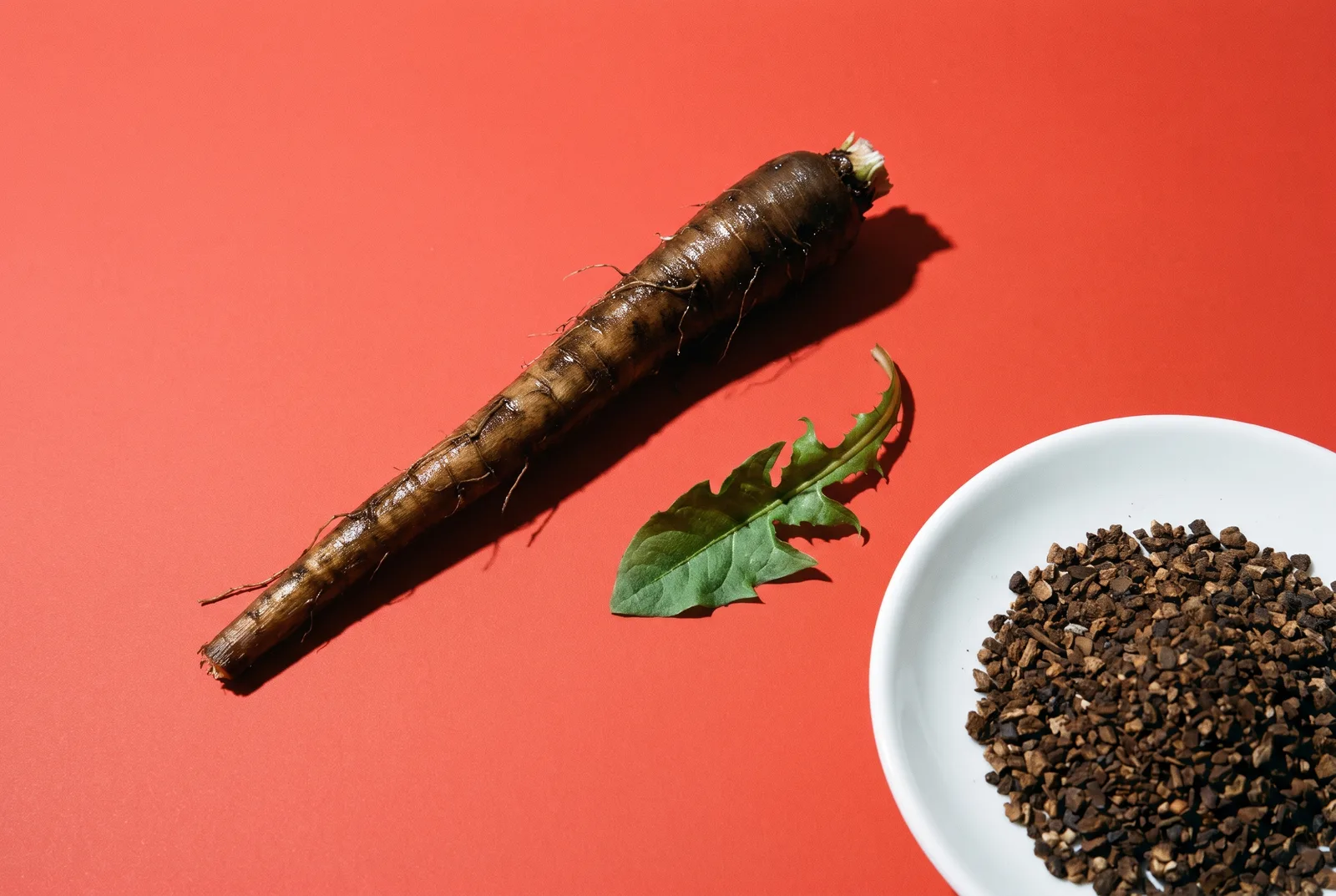
| Root | Dried and steeped as tea, roasted as a caffeine-free coffee substitute, or sold as capsules and tinctures. Bitter and earthy, closer to chicory than to the leaves. | Mostly cell and animal studies. The root is naturally high in inulin, a fermentable fiber. |
| Leaf | Eaten fresh as a salad green or taken as a liquid extract. | The one human diuretic trial used leaf extract. Greens are also a food source of minerals. |
| Flower | Dandelion wine and food coloring. | The least research of the three. |
Leaves are the culinary part. A food-composition analysis found dandelion greens carry relatively high amounts of iron and manganese among the minerals measured, along with fiber [PMID 36478818]. That is a statement about eating greens, not about taking a root supplement.
How people take it
Most dandelion root sold today comes in one of four forms. Which one you choose changes the experience more than any claimed difference in effect.
- Dried cut root tea: usually 1 to 2 teaspoons steeped in hot water for 10 to 15 minutes.
- Roasted root: ground and brewed like coffee. Roasting mellows the bitterness and gives a coffee-like flavor with no caffeine.
- Capsules or powder: the milligram amount varies widely between brands.
- Liquid extract or tincture: dried root soaked in an alcohol-water mixture, often around a 1:5 ratio in herbal practice.
Extract labels can be confusing. A ratio such as 4:1 or 10:1 means that many parts of raw root went into one part of finished extract. It describes concentration, not a verified amount of any active compound.
How it might work in the body
The best-supported effect in people is also the most modest. In a 2009 pilot study, 17 healthy adults took 8 mL of a liquid dandelion leaf extract three times in one day. Urination frequency rose after the first two doses, with no further change after the third [PMID 19678785]. There was no placebo-controlled comparison and no one has run a comparable human trial on root.
Beyond that, proposed mechanisms come from the lab. Leaf and root extracts showed antioxidant activity and reduced fat accumulation in mouse fat cells in a culture dish [PMID 29083390]. Extracts also dampened an inflammatory signaling pathway in immune cells exposed to a bacterial toxin [PMID 21075189]. These findings show what compounds in the plant can do in isolation. They do not show what happens after you drink a cup of tea.
The root's inulin is a more mundane mechanism. It is a fiber that gut bacteria ferment, which is one plausible reason some people notice digestive changes, including looser stools or gas. A federal drug-safety monograph notes the inulin content and lists rare allergic reactions, diarrhea and general GI upset, without giving a rate [PMID 30000932].
What the evidence does and does not support
For nearly every question people ask about dandelion, the answer is "studied in animals or cells, not yet in people." Here is the landscape in short form.
| Claim area | What has been tested | Human evidence |
|---|---|---|
| Diuretic effect | Leaf extract in 17 healthy adults over one day [PMID 19678785] | One small pilot, leaf only |
| Digestion and liver | Reviews of traditional use [PMID 35405251, PMID 41373965]; rat liver-injury models with root extract [PMID 33804908, PMID 32970799] | None; reviewers call for clinical research |
| Blood sugar and lipids | Mouse high-fat-diet study with leaf extract [PMID 23603008]; reviews of rodent work [PMID 33498684, PMID 38351703] | No completed human trial cited |
| Stress and mood | Mice given extracts showed less despair behavior and lower stress hormones [PMID 24611722, PMID 30636257] | None |
| Fatigue and endurance | Mouse swim tests [PMID 22238492] | None; this is physical fatigue in animals |
| Cancer | Root extract killed colon cancer cells in a dish and slowed implanted tumors in mice [PMID 27564258] | None |
| Infections | Lab-dish effects on flu virus, a yeast and others [PMID 22168277, PMID 31746416] | None |
Two details are worth noticing. First, some lab findings occurred at concentrations far above a tea or capsule dose, as with the yeast study [PMID 31746416]. Second, several animal studies used isolated compounds such as taraxasterol, not whole root, so they say little about a supplement.
Dandelion also appears in multi-herb products, which blur the picture further. A pilot trial of a six-herb blend including dandelion measured hormones in premenopausal women, not menopause symptoms, and could not isolate dandelion's contribution [PMID 17684134]. For a fuller walk-through of the research, see what the research shows.
Who dandelion is for, and who should be cautious
Realistically, dandelion suits people who like bitter herbal teas, want a caffeine-free coffee alternative, or enjoy the greens as food. It is a reasonable low-stakes curiosity for a healthy adult. It is not a replacement for medical care, and it should not be used to treat a condition.
Dandelion belongs to the Asteraceae family, which includes ragweed, chrysanthemum and daisies. In a review of skin-prick tests from 6,497 allergy patients, dandelion pollen sensitized 8.5% of them, often alongside mugwort and chrysanthemum sensitivity [PMID 18219834]. Sesquiterpene lactones in this plant family are the main triggers behind contact reactions, from mild eczema to, rarely, more serious allergic responses [PMID 30666578]. In a patch-test study, the few people who reacted to dandelion extract all had eczema already [PMID 15479198].
- People with known allergies to related plants, or with eczema, have more reason to avoid it.
- People with sensitive digestion may find the inulin in root unwelcome.
- Anyone taking prescription medication, especially diuretics, or with kidney, gallbladder or bile-duct problems, should check with a clinician first.
- Pregnant or breastfeeding people should ask their clinician, as should anyone planning surgery.
The medication and condition cautions above are standard prudence for an herb with a diuretic reputation, not findings from the studies cited here. For a longer checklist, see who should not take dandelion.
Choosing a product sensibly
Start with the label. It should name the plant part, root or leaf, because research on one does not carry over to the other. If the amount per serving is not clear, or if it is only a proprietary blend, treat that as a reason to look elsewhere.
Sourcing matters for a plant that grows by roadsides. A 2024 field study found dandelions near an industrial site accumulated measurably more metals than those near a forest, and the authors concluded the plant should be harvested from clean ground for medicinal use [PMID 38999644]. Independent testing for contaminants is a sensible thing to look for, and foraging from lawns or roadsides is a poor substitute.
Start with a small amount, such as one cup of tea, and watch how your digestion responds before increasing. If you do not notice anything or feel worse, there is no evidence that more will help. Do not give dandelion to pets on the strength of a supplement label, as no dedicated research supports it and animal dosing is a veterinary question.
The bottom line
Dandelion is a familiar plant with a long traditional record and a small, mostly preclinical research base. The single human diuretic pilot used leaf extract, and the many promising lab and animal findings have not been tested in people at realistic doses.
That makes dandelion a reasonable herbal tea or green, and a poor candidate for health promises. Treat anything beyond that as a hypothesis, not a result.
Frequently asked questions
Does dandelion root tea contain caffeine?
No. Dandelion is not a caffeine-containing plant. Roasted root is brewed like coffee and sold as a caffeine-free substitute, with a bitter, earthy flavor that roasting mellows. Check blended products, though, since some tea or coffee-style mixes add caffeinated ingredients such as black tea or coffee.
What does dandelion taste like?
Root tastes bitter and earthy, often compared with chicory or burdock root. Roasting caramelizes natural sugars and brings it closer to coffee. Leaves taste green and bitter, and are eaten fresh in salads or cooked like other bitter greens. Flowers are milder and used in wine and coloring.
Can I give dandelion to my dog, cat or horse?
There is no dedicated research on giving dandelion root to pets or horses, and animal dosing is not a scaled-down version of human dosing. Ask a veterinarian before giving any herbal product to an animal, particularly if it takes medication or has a health condition.
What does a ratio like 10:1 on a dandelion extract mean?
It means about ten parts of raw root went into one part of finished extract, so it describes concentration. It does not tell you how much of any specific active compound is present. Compare the milligrams per serving and the plant part named on the label.
Sources (27)
- Clare BA, et al. The diuretic effect in human subjects of an extract of Taraxacum officinale folium over a single day. J Altern Complement Med. 2009.
- Schütz K, et al. Taraxacum--a review on its phytochemical and pharmacological profile. J Ethnopharmacol. 2006.
- Dandelion. . 2006.
- Fan M, et al. Dandelion (Taraxacum Genus): A Review of Chemical Constituents and Pharmacological Effects. Molecules. 2023.
- Li Y, et al. The potential of dandelion in the fight against gastrointestinal diseases: A review. J Ethnopharmacol. 2022.
- Teterovska R, et al. Medicinal Plants in Food Supplements for Gastrointestinal Disorders: Critical Assessment of Health Claims on Gastric Acid Regulation. Nutrients. 2025.
- Hao F, et al. Taraxacum: A Review of Ethnopharmacology, Phytochemistry and Pharmacological Activity. Am J Chin Med. 2024.
- Ignat MV, et al. Plants of the Spontaneous Flora with Beneficial Action in the Management of Diabetes, Hepatic Disorders, and Cardiovascular Disease. Plants (Basel). 2021.
- Davaatseren M, et al. Taraxacum official (dandelion) leaf extract alleviates high-fat diet-induced nonalcoholic fatty liver. Food Chem Toxicol. 2013.
- Li YC, et al. Antidepressant effects of the water extract from Taraxacum officinale leaves and roots in mice. Pharm Biol. 2014.
- Gao C, et al. Antidepressive Effects of Taraxacum Officinale in a Mouse Model of Depression Are Due to Inhibition of Corticosterone Levels and Modulation of Mitogen-Activated Protein Kinase Phosphatase-1 (Mkp-1) and Brain-Derived Neurotrophic Factor (Bdnf) Expression. Med Sci Monit. 2019.
- Chandrasekhar K, et al. A prospective, randomized double-blind, placebo-controlled study of safety and efficacy of a high-concentration full-spectrum extract of ashwagandha root in reducing stress and anxiety in adults. Indian J Psychol Med. 2012.
- Arumugam V, et al. Effects of Ashwagandha (Withania Somnifera) on stress and anxiety: A systematic review and meta-analysis. Explore (NY). 2024.
- Ovadje P, et al. Dandelion root extract affects colorectal cancer proliferation and survival through the activation of multiple death signalling pathways. Oncotarget. 2016.
- Pfingstgraf IO, et al. Protective Effects of Taraxacum officinale L. (Dandelion) Root Extract in Experimental Acute on Chronic Liver Failure. Antioxidants (Basel). 2021.
- Eshrati R, et al. Comparison of ameliorative effects of Taraxacum syriacum and N-acetylcysteine against acetaminophen-induced oxidative stress in rat liver and kidney. J Biochem. 2021.
- García-Carrasco B, et al. In vitro Hypolipidemic and Antioxidant Effects of Leaf and Root Extracts of Taraxacum Officinale. Med Sci (Basel). 2015.
- Park CM, et al. Taraxacum officinale Weber extracts inhibit LPS-induced oxidative stress and nitric oxide production via the NF-κB modulation in RAW 264.7 cells. J Ethnopharmacol. 2011.
- Lee YW, et al. Cross-allergenicity of pollens from the Compositae family: Artemisia vulgaris, Dendranthema grandiflorum, and Taraxacum officinale. Ann Allergy Asthma Immunol. 2007.
- Denisow-Pietrzyk M, et al. Asteraceae species as potential environmental factors of allergy. Environ Sci Pollut Res Int. 2019.
- Jovanović M, et al. Sesquiterpene lactone mix patch testing supplemented with dandelion extract in patients with allergic contact dermatitis, atopic dermatitis and non-allergic chronic inflammatory skin diseases. Contact Dermatitis. 2004.
- Respondek Z, et al. Biomonitoring with the Use of the Herbal Plant Taraxacum officinale as a Source of Information on Environmental Contamination. Plants (Basel). 2024.
- Greenlee H, et al. A pilot and feasibility study on the effects of naturopathic botanical and dietary interventions on sex steroid hormone metabolism in premenopausal women. Cancer Epidemiol Biomarkers Prev. 2007.
- Liang Y, et al. Extraction and isolation of the active ingredients of dandelion and its antifungal activity against Candida albicans. Mol Med Rep. 2020.
- He W, et al. Anti-influenza virus effect of aqueous extracts from dandelion. Virol J. 2011.
- de Almeida LC, et al. Proximate composition and characterization of the vitamins and minerals of dandelion (Taraxacum officinale) from the Middle Doce River region - Minas Gerais, Brazil. Heliyon. 2022.
- Jinchun Z, et al. The effects of Taraxacum officinale extracts (TOE) supplementation on physical fatigue in mice. Afr J Tradit Complement Altern Med. 2011.
Adapted from research by the Electric Tiger editorial team — read the original.