Dandelion
Dandelion supplement buying guide: forms, labels and price
Dandelion has no established clinical dose and no standard marker compound, so choosing well means reading plant part, form, sourcing and testing rather than chasing milligrams.
By Artifact Editors, Editorial team
Published · 5 min read
In this article
- Start with what the evidence can't tell you
- Root, leaf or blend: read the plant part first
- Forms compared: tea, powder, capsules, liquid, gummies
- Gummies: the weakest value on plant material
- Label red flags
- Third-party testing, and why metals matter here
- Price per effective dose, honestly framed
- Safety checks before you buy
- FAQ
Start with what the evidence can't tell you
Most supplement shopping assumes a target: a dose that trials found useful, and a label that either meets it or doesn't. Dandelion doesn't offer one. A 2006 pharmacology review and a 2023 review both describe the bulk of the research as lab and animal work, with traditional digestive and liver use resting on long habit rather than clinical trials.
The one human trial of dandelion as a diuretic gave 17 healthy adults 8 mL of a liquid leaf extract, three times over a single day. Urination frequency rose after the first two doses. That was a leaf, in liquid form, for one day, so it does not set a dose for root powder, capsules, tea or gummies.
This changes the job. You are not looking for the product that matches a research amount. You are looking for a product that tells you plainly what it contains, where it came from and who checked it. For the wider context, see our dandelion topic page.
Root, leaf or blend: read the plant part first
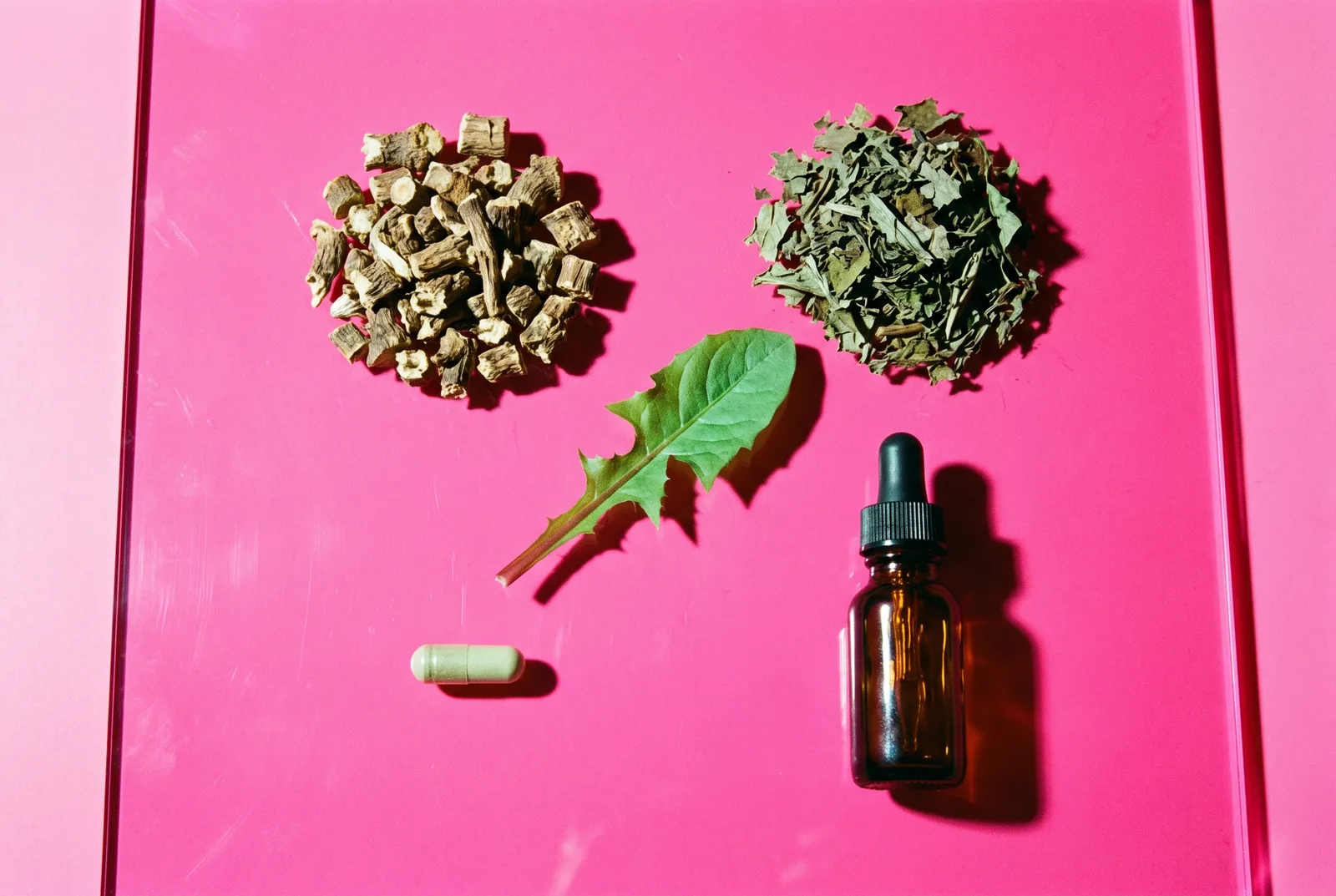
Root and leaf are used differently and studied differently. The human diuretic trial used leaf. A food-composition analysis of the greens (leaves) found relatively high iron and manganese alongside fiber, while much of the animal and cell work on digestion and liver markers used root extracts. A label that says only 'dandelion' leaves you guessing about which body of research, if any, is even loosely relevant.
A root-and-leaf blend isn't a defect. It should simply be stated. 'Aerial parts' means the above-ground plant, not root. If you wanted root, confirm the word appears on the panel.
Forms compared: tea, powder, capsules, liquid, gummies
No study has compared one dandelion form against another for absorption or effect, so none can be called better on evidence. The differences are practical: how much plant material you get, how easy it is to judge quality, and what else comes along with it.
| Form | What it is | What to check | Tradeoff |
|---|---|---|---|
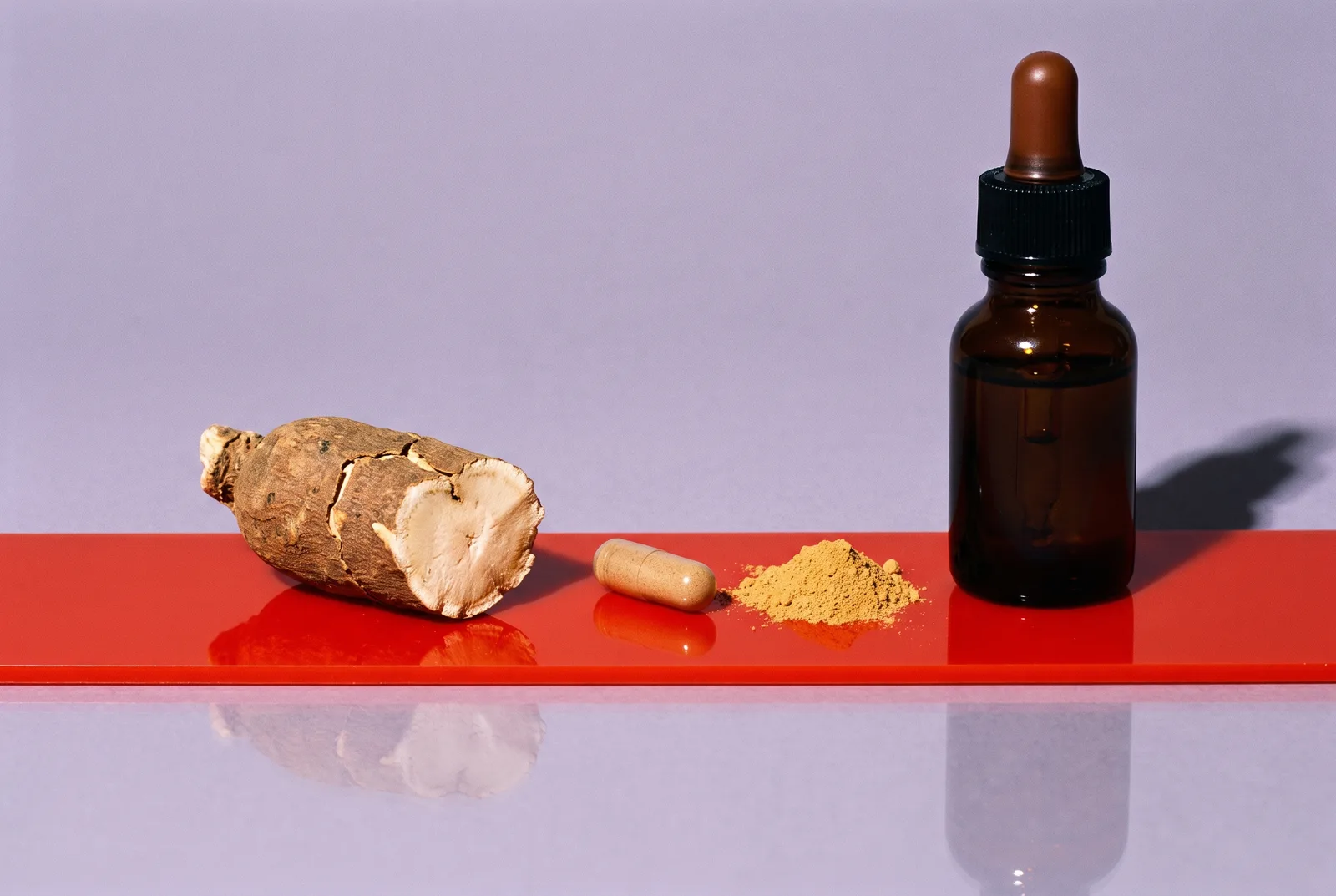
| Cut root (tea) | Dried, cut root; commonly 1–2 teaspoons per cup, simmered 10–15 minutes | Color tan to brown, no musty smell; root vs. leaf stated | Least processed and easiest to judge by eye; needs preparing |
| Powder or capsules | Dried, ground root, often 500–550 mg per capsule | 'Other ingredients' line; plant part; sourcing | Convenient; harder to verify by eye; includes the root's natural inulin |
| Liquid extract or tincture | Root or leaf concentrated with water, glycerin or alcohol | A stated ratio (such as 1:5 or 4:1); solvent used | Easy to adjust in small amounts; a bare 'extract' reveals nothing about strength |
| Gummies | Small amount of extract in a sweetened, gelled base | Milligrams of dandelion; gelling agent; added sugar or sugar alcohols | Palatable; carries the least plant material per piece |
Powder and extract are not interchangeable milligram for milligram. A 4:1 extract means four parts raw herb went into one part of finished product, while powder is the root itself. No research establishes a conversion between them.
Gummies: the weakest value on plant material
A gummy is a delivery format, not a different ingredient. Dandelion root is bitter, and a gummy has to stay chewable, so makers typically use a small amount of extract and mask it with flavoring. Sugar, corn syrup or sugar alcohols make up a meaningful share of each piece's weight, and sugar alcohols can upset the stomach in larger amounts.
The fair comparison is the stated milligrams of dandelion in a gummy against the milligrams in a capsule, not against a clinical target. Check the gelling agent too: gelatin-based gummies aren't vegan, while pectin-based ones typically are. No trial has tested dandelion gummies.
Label red flags
- No plant part named. 'Dandelion' alone, or 'herbal complex,' hides whether you're buying root, leaf or both.
- An extract with no ratio. The word 'extract' without 1:5, 4:1 or similar tells you almost nothing about concentration.
- A proprietary blend. If dandelion shares a total milligram figure with other herbs, you can't tell how much dandelion is in it.
- 'No fillers' as the headline. The phrase has no enforced definition. A capsule shell and a flow agent are ordinary; what matters is that the 'other ingredients' line is disclosed and short for a single-ingredient product.
- 'Third-party tested' with no document. The phrase can mean one lab checked one thing, once.
- Wildcrafted with no location. Dandelion pulls up what's in its soil, so unknown ground is an unknown risk.
- Disease claims. Anything saying dandelion treats or prevents a condition goes beyond the evidence. A 2025 review of digestive supplements found label claims for dandelion rest mainly on traditional use.
'Organic' deserves a similar read. A real USDA Organic seal verifies growing and handling methods, but it does not by itself verify metal content, potency or identity.
Third-party testing, and why metals matter here
Dandelion is a bioaccumulator. A 2024 field study compared plants near a forest with plants near a steel mill and found measurably higher metal levels in the industrial-site plants. The authors concluded that dandelion should be harvested from clean ground if used medicinally. That makes a heavy-metal result more relevant for dandelion than for many other botanicals.
The concrete version of a testing claim is a certificate of analysis (COA) for your specific batch. A useful one names what was tested, such as identity, heavy metals and microbes, and shows numbers against a limit rather than a bare pass logo. If a seller won't produce one on request, treat that as information. Our longer explainer on what third-party testing seals mean for dandelion covers the panel details.
Price per effective dose, honestly framed
'Price per effective dose' is a phrase dandelion can't support, because no effective dose has been established. A $40 extract is not more research-backed than a $10 tea box; neither has a dose-response trial behind it. What you can calculate is price per serving, and then price per gram of plant material, which is closer to what you are actually buying.
Here is an illustration with round numbers. A $12 box of 20 tea bags is $0.60 a bag, and at 1–2 g of cut root per bag that works out to roughly $0.30–$0.60 per gram. A $22 bottle of 60 capsules is about $0.37 a capsule, and at 500 mg of powder per capsule (30 g total) it is closer to $0.73 per gram. The capsule is dearer per gram and cheaper per serving, which is why the serving size has to be read first.
Bulk cut root sold by weight is usually the cheapest route to plant material. Capsules and extracts cost more for convenience and consistency. Organic certification, testing, extraction method and sourcing also push prices up, and those are legitimate reasons if the documentation exists. For a worked method, see how to compare dandelion prices per serving.
Safety checks before you buy
Dandelion is a common food plant, and a federal drug-safety monograph notes it can rarely cause allergic reactions, diarrhea and general GI upset, without giving a rate. The root is also naturally high in inulin, a fiber that can add to gas or bloating in some people.
Dandelion belongs to the Asteraceae family, with ragweed, chrysanthemums, marigolds and daisies. In a review of skin-prick tests from 6,497 allergy patients, dandelion pollen sensitized 8.5%, usually alongside other plants in the family. A patch-test study found allergic skin reactions to dandelion extract in a small number of people, all of whom already had eczema. If you react to those relatives, that is worth weighing before choosing any form.
Frequently asked questions
Is a higher extract ratio always stronger?
Not in a way you can verify. A 10:1 ratio describes how concentrated the process was, not a measured amount of a specific active compound, because dandelion root has no industry-standard marker to test for. Treat the ratio as a rough concentration clue, and compare it alongside the stated milligrams per serving.
Does 'organic' mean a dandelion product is free of heavy metals?
No. Organic certification covers growing and handling methods such as avoiding synthetic pesticides. It doesn't test for heavy metals or confirm potency. A product can be organic without metal testing, or tested without being organic, so look for each claim separately.
Are liquid extracts a better choice than capsules?
There is no research basis for calling either better, since no study has compared the two forms. Liquids are easier to adjust in small amounts and contain a solvent such as alcohol or glycerin. Capsules are simpler to dose by the label. Quality depends on the stated ratio and sourcing.
Should I buy wild-harvested dandelion root?
Only if the seller states where it was harvested and can show contaminant testing. Dandelion takes up metals from its soil, and a 2024 field study found higher levels in plants near an industrial site. Roadsides, treated lawns and unknown ground carry a real question mark.
Sources (10)
- Clare BA, et al. The diuretic effect in human subjects of an extract of Taraxacum officinale folium over a single day. J Altern Complement Med. 2009.
- Schütz K, et al. Taraxacum--a review on its phytochemical and pharmacological profile. J Ethnopharmacol. 2006.
- Fan M, et al. Dandelion (Taraxacum Genus): A Review of Chemical Constituents and Pharmacological Effects. Molecules. 2023.
- Dandelion. . 2006.
- Respondek Z, et al. Biomonitoring with the Use of the Herbal Plant Taraxacum officinale as a Source of Information on Environmental Contamination. Plants (Basel). 2024.
- Lee YW, et al. Cross-allergenicity of pollens from the Compositae family: Artemisia vulgaris, Dendranthema grandiflorum, and Taraxacum officinale. Ann Allergy Asthma Immunol. 2007.
- Jovanović M, et al. Sesquiterpene lactone mix patch testing supplemented with dandelion extract in patients with allergic contact dermatitis, atopic dermatitis and non-allergic chronic inflammatory skin diseases. Contact Dermatitis. 2004.
- de Almeida LC, et al. Proximate composition and characterization of the vitamins and minerals of dandelion (Taraxacum officinale) from the Middle Doce River region - Minas Gerais, Brazil. Heliyon. 2022.
- Teterovska R, et al. Medicinal Plants in Food Supplements for Gastrointestinal Disorders: Critical Assessment of Health Claims on Gastric Acid Regulation. Nutrients. 2025.
- Denisow-Pietrzyk M, et al. Asteraceae species as potential environmental factors of allergy. Environ Sci Pollut Res Int. 2019.
Adapted from research by the Electric Tiger editorial team — read the original.