Milk thistle
Milk thistle: what it is, how it works, and what research shows
A plain-English guide to milk thistle and silymarin: how the body handles it, where trials show a signal, where they come up empty, and who should be careful.
By Artifact Editors, Editorial team
Published · 6 min read
In this article
What milk thistle is
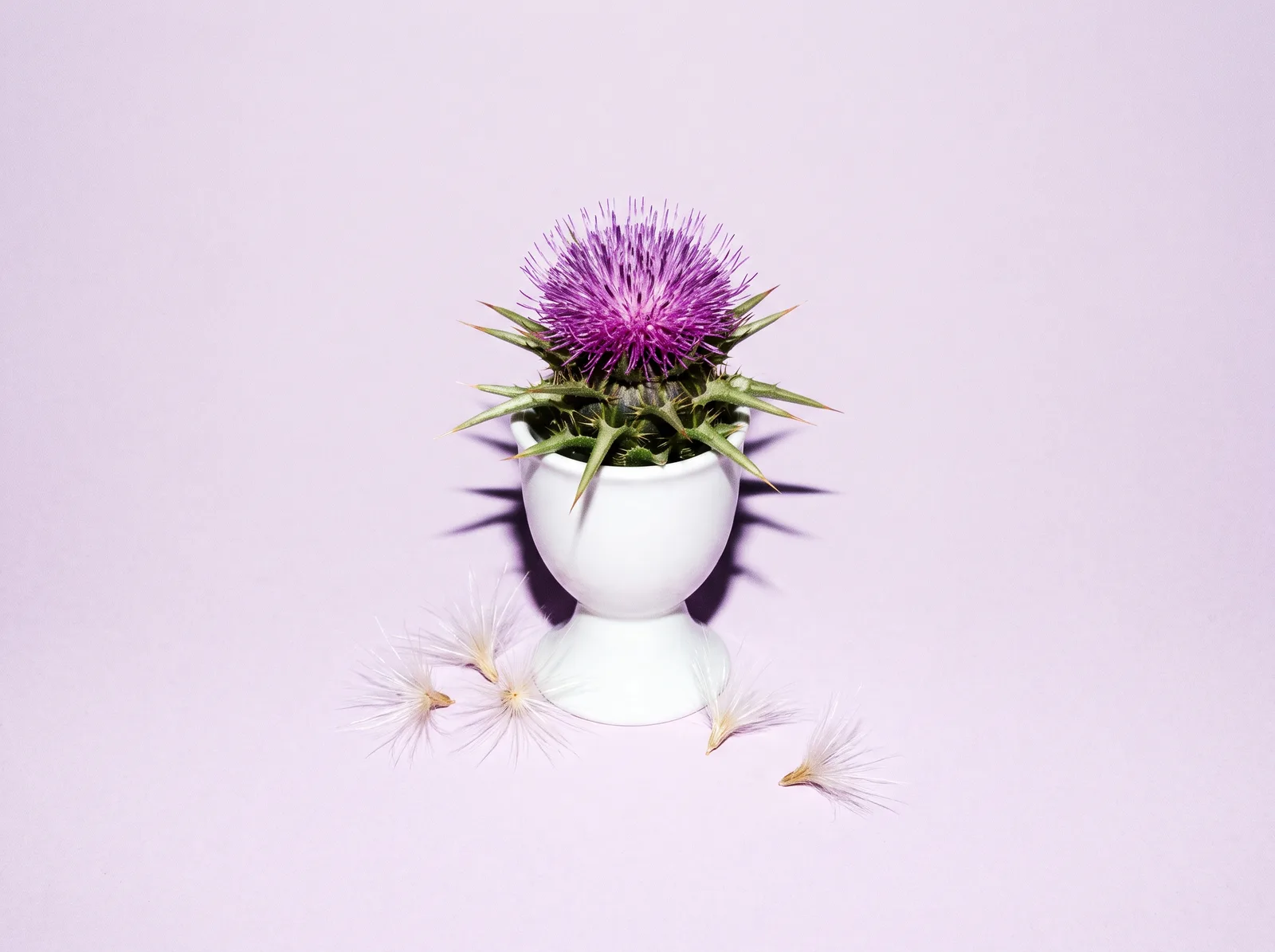
Milk thistle (Silybum marianum) is a tall, spiny plant with purple flower heads and white-veined leaves. It belongs to the daisy family, the same botanical family as ragweed, artichokes and daisies. The part used in supplements is the fruit, usually called the seed.
The seeds contain silymarin, a mixture of compounds called flavonolignans. Silibinin (also written silybin) is the main and most-studied component, with smaller amounts of silychristin and silydianin. A 2018 review describes the complex in just those terms and notes that the clinical case for liver disease still needs stronger trials.
You will find it as capsules, tablets, tinctures and tea. It is marketed mostly for liver support, and to a lesser degree for digestion. That is a description of why people buy it, not a finding. The rest of this guide covers what has actually been measured; our milk thistle hub collects deeper pieces on individual questions.
How it works in the body
The usual shorthand is that silymarin is an antioxidant and anti-inflammatory compound. Some trials have measured markers of inflammation and oxidative stress, and a small kidney trial reported lower levels with silymarin. But the more practical story is about absorption, because getting silymarin into the bloodstream is the hard part.
A 2021 systematic review found that silymarin's active compounds are poorly absorbed when swallowed. The body processes and excretes them quickly, so little reaches circulation. That means the number on the label and the amount your tissues see can be far apart.
Manufacturers have tried to close the gap. A 2005 review found that binding silibinin to phosphatidylcholine, a so-called phytosome complex, improves absorption compared with plain silymarin extract. Separately, a 2019 study in rats found that piperine, the active compound in black pepper, raised silibinin availability by 146–181% by blocking transporters that pump it back out of cells. That is an animal and cell-line result. It has not been shown in people.
Poor absorption may be one reason trial results are hard to compare across products and doses, though the sources here do not prove that. It does explain why standardization and formulation matter more than they do for many supplements.
What the liver evidence shows
Liver health is the traditional use and the best-studied one. The results depend heavily on which liver condition is being studied.
| Population | What trials found | How to read it |
|---|---|---|
| Fatty liver (NAFLD/NASH) | A 2024 pooled analysis of 26 trials found better lipid markers and liver enzymes, and better histology in a subset with biopsy data | The most encouraging signal; the authors called for confirmation |
| Mixed liver disease | A 2017 pooled analysis of 6 trials found ALT and AST lower by a statistically significant but clinically negligible amount; gamma-GT unchanged | Real on paper, small in practice |
| Chronic hepatitis C | In 154 people, doses up to 2,100 mg/day for 24 weeks did no better than placebo on liver enzymes or viral levels | Negative |
| Alcoholic cirrhosis | In 200 people, 450 mg/day for 2 years had no effect on survival or the clinical course of disease | Negative |
One more data point: a 3-month, placebo-controlled trial of a six-ingredient mixture that included silymarin and curcumin, in 113 people with a diagnosed liver condition, found no significant difference from placebo. A 4-week pilot in 15 people reported improvements with silymarin and curcumin, but it was small and its abstract describes no placebo group.
The fair summary is that milk thistle may have a modest role in fatty liver disease, with confirmation pending, and little to show in viral hepatitis or alcohol-related cirrhosis. It is not a replacement for medical care of any liver condition.
Cholesterol, kidneys and other measured effects
A 2024 pooled analysis of 33 trials (1,943 people) found that silymarin lowered total cholesterol, triglycerides and LDL compared with control. HDL, body weight and BMI did not change significantly. The authors say larger, longer trials are needed to confirm it.
Kidney results are mixed. A small trial in people with diabetic kidney disease found that 420 mg/day for 3 months reduced a urine-protein marker more than placebo. A larger trial found no significant difference in kidney function decline, dialysis need or death, although hospitalizations were lower with silymarin.
Some smaller studies have looked at silymarin alongside medical treatment:
- Chemotherapy support: in 30 breast cancer patients, 420 mg/day reduced liver damage severity on ultrasound after a month, though blood-based liver tests did not differ. In 70 colorectal cancer patients, silymarin was linked to less diarrhea and nausea, with no difference in liver toxicity. These are pilot-scale trials, not evidence that milk thistle treats cancer, and anyone in treatment should clear it with their oncology team.
- Heart surgery: a 2024 controlled study of 160 bypass patients found fewer cases of postoperative atrial fibrillation after 400 mg of silymarin beforehand. The study does not state that it was randomized or blinded.
- Weight and blood sugar: a 52-week trial of a berberine-silymarin combination reduced abdominal fat and metabolic markers in obese adults with type 2 diabetes. Berberine has its own metabolic effects, so the result cannot be credited to milk thistle.
Where the evidence is thin or missing
Many claims attached to milk thistle rest on animal studies, lab dishes or combination products. They are worth knowing about mainly so you can discount them.
- Breast milk supply: an NIH monograph reports no valid clinical trial support for milk thistle increasing milk supply.
- Menopause: the available work is in rats and isolated animal tissue, including cardiovascular markers, blood vessel relaxation and bone. None of it tests a menopause symptom in a person.
- Mood and behavior: in a placebo-controlled trial of 43 adults, 300–600 mg/day of silymarin did no better than placebo on gambling, depression or anxiety scores over 8 weeks. A systematic review of stress-related effects describes mostly animal and lab measures, and its authors call for more clinical studies.
- Infections: silymarin showed some antibacterial and antifungal activity in lab dishes, at concentrations well above what a swallowed dose is known to reach in blood. Those are test-tube results, not treatments.
- Skin: small studies of topical products exist for acne, eczema and rosacea, but many lacked a placebo group or tested a blend of ingredients. One acne split-face trial saw improvement on both the silymarin and the salicylic acid side. The eczema evidence in mice is animal only.
- Iron overload: in transfusion-dependent thalassemia, adding silymarin to chelation drugs lowered blood ferritin, but a smaller analysis found no significant reduction in liver iron itself.
- Inflammatory bowel disease: a 2015 review lists silymarin among herbs studied, without reporting a specific trial result or ranking it among the best-supported options.
Safety, allergy and drug interactions
Silymarin looks well tolerated. A 2019 safety review found it generally well tolerated in humans, even at high doses for 24 weeks, with gastrointestinal upset the main limiting side effect. The NIH monograph adds occasional stomach or skin reactions.
The allergy point is easy to miss. Because milk thistle belongs to the daisy family, the monograph flags rare but real cross-reactivity in people allergic to ragweed-family plants.
Drug interactions are less clear-cut. In a 2009 trial, 420 mg/day of silymarin for 14 days changed blood levels of the blood pressure drug losartan in healthy volunteers, but the effect depended on each person's CYP2C9 genotype. In a 2014 study, a standardized extract taken three times daily for 14 days had no significant effect on four major drug-metabolizing liver enzymes. Those findings do not contradict each other so much as show that the answer varies by drug and by person. If you take prescription medication, tell your pharmacist.
Who it's for, and how to choose a product
Milk thistle is best viewed as an option to discuss with a clinician for adults with fatty liver or elevated lipids, where pooled trials show a signal, rather than a general wellness supplement. People who are healthy and simply want a liver cleanse have no trial evidence addressed to them. People with ragweed-family allergies, those on prescription drugs or chemotherapy, and anyone pregnant or breastfeeding should ask first.
If you decide to try it, three label details matter. First, look for an extract standardized to a stated percentage of silymarin. A line reading only "milk thistle extract 1,000 mg" does not tell you how much silymarin you are getting. Second, capsules and tablets of standardized extract are the form used in essentially all human research. Tea is less predictable, since silymarin's components dissolve poorly in water. Third, phytosome products bind silibinin to phosphatidylcholine to improve absorption, which may justify the higher price.
Trial doses ranged from 300 to 600 mg/day of silymarin in most studies, with one hepatitis C trial going to 2,100 mg/day. For how those numbers translate to products, see how much milk thistle to take and how to choose a milk thistle supplement.
Frequently asked questions
Does milk thistle detox the liver?
No study reviewed here tests a liver detox in healthy people. The trials enrolled people with specific conditions, and results ranged from modest in fatty liver to negative in hepatitis C and alcoholic cirrhosis. The liver clears substances on its own, and "detox" is a marketing term rather than a measured outcome.
How long can people take milk thistle?
Trial lengths ranged from 14 days to 2 years. A 2019 safety review found silymarin generally well tolerated, even at high doses for 24 weeks. Trials this long do not establish safety for indefinite daily use, so a periodic check-in with a clinician is reasonable.
Does milk thistle increase breast milk supply?
The evidence does not support it. An NIH reference monograph reports no valid clinical trial showing milk thistle increases milk supply. Anyone breastfeeding who is considering a supplement should talk with a lactation consultant or clinician first.
Is milk thistle tea as effective as capsules?
There is no evidence that it is. Essentially all human research used standardized extract in capsules or tablets. Silymarin's components dissolve poorly in water, so a tea infusion delivers a less predictable amount, and silymarin is already poorly absorbed even in concentrated form.
Sources (39)
- Abenavoli L, et al. Milk thistle (Silybum marianum): A concise overview on its chemistry, pharmacological, and nutraceutical uses in liver diseases. Phytother Res. 2018.
- Tvrdý V, et al. Systematic review of pharmacokinetics and potential pharmacokinetic interactions of flavonolignans from silymarin. Med Res Rev. 2021.
- Kidd P, et al. A review of the bioavailability and clinical efficacy of milk thistle phytosome: a silybin-phosphatidylcholine complex (Siliphos). Altern Med Rev. 2005.
- Bi X, et al. Piperine enhances the bioavailability of silybin via inhibition of efflux transporters BCRP and MRP2. Phytomedicine. 2019.
- Fallahzadeh MK, et al. Effect of addition of silymarin to renin-angiotensin system inhibitors on proteinuria in type 2 diabetic patients with overt nephropathy: a randomized, double-blind, placebo-controlled trial. Am J Kidney Dis. 2012.
- Voroneanu L, et al. Addition of silymarin to renin-angiotensin system blockers in normotensive patients with type 2 diabetes mellitus and proteinuria: a prospective randomized trial. Int Urol Nephrol. 2017.
- de Avelar CR, et al. Effect of silymarin on biochemical indicators in patients with liver disease: Systematic review with meta-analysis. World J Gastroenterol. 2017.
- Li S, et al. Administration of silymarin in NAFLD/NASH: A systematic review and meta-analysis. Ann Hepatol. 2024.
- Fried MW, et al. Effect of silymarin (milk thistle) on liver disease in patients with chronic hepatitis C unsuccessfully treated with interferon therapy: a randomized controlled trial. JAMA. 2012.
- Parés A, et al. Effects of silymarin in alcoholic patients with cirrhosis of the liver: results of a controlled, double-blind, randomized and multicenter trial. J Hepatol. 1998.
- Cerletti C, et al. Randomised trial of chronic supplementation with a nutraceutical mixture in subjects with non-alcoholic fatty liver disease. Br J Nutr. 2020.
- Elgendy EM, et al. Therapeutic Effects of Curcuminoids and Silymarin, Individually and in Combination, in Patients With Hepatic Impairment. Chem Biodivers. 2025.
- Mohammadi S, et al. Impacts of Supplementation with Silymarin on Cardiovascular Risk Factors: A Systematic Review and Dose-Response Meta-Analysis. Antioxidants (Basel). 2024.
- Moezian GSA, et al. Oral silymarin formulation efficacy in management of AC-T protocol induced hepatotoxicity in breast cancer patients: A randomized, triple blind, placebo-controlled clinical trial. J Oncol Pharm Pract. 2022.
- Chang TK, et al. A Pilot Study of Silymarin as Supplementation to Reduce Toxicities in Metastatic Colorectal Cancer Patients Treated With First-Line FOLFIRI Plus Bevacizumab. Oncol Res. 2021.
- Okiljevic B, et al. The Effect of Silymarin on the Prevention of Atrial Fibrillation After Coronary Artery Bypass Grafting. Braz J Cardiovasc Surg. 2024.
- Guarino G, et al. Bioimpedance analysis, metabolic effects and safety of the association Berberis aristata/Bilybum marianum: a 52-week double-blind, placebo-controlled study in obese patients with type 2 diabetes. J Biol Regul Homeost Agents. 2017.
- Tabeshpour J, et al. The regulatory role of curcumin on platelet functions. J Cell Biochem. 2018.
- Milk Thistle. . 2006.
- Maleki N, et al. Comparative effects of estrogen and silibinin on cardiovascular risk biomarkers in ovariectomized rats. Gene. 2022.
- Demirci B, et al. Silymarin improves vascular function of aged ovariectomized rats. Phytother Res. 2014.
- Mohd Fozi NF, et al. Milk thistle: a future potential anti-osteoporotic and fracture healing agent. Curr Drug Targets. 2013.
- Grant JE, et al. Silymarin (Milk Thistle) Treatment of Adults With Gambling Disorder: A Double-Blind, Placebo-Controlled Trial. Clin Neuropharmacol. 2024.
- Rostamian S, et al. The Therapeutic Effect of Silymarin and Silibinin on Depression and Anxiety Disorders and Possible Mechanism in the Brain: A Systematic Review. Cent Nerv Syst Agents Med Chem. 2023.
- de Oliveira DR, et al. In vitro antimicrobial and modulatory activity of the natural products silymarin and silibinin. Biomed Res Int. 2015.
- Cwikla C, et al. Investigations into the antibacterial activities of phytotherapeutics against Helicobacter pylori and Campylobacter jejuni. Phytother Res. 2010.
- Atallah DA, et al. Topical Silymarin Cream as a Novel Therapy Versus Salicylic Acid Peels in Acne Vulgaris: A Split-Face Clinical Trial. J Cutan Med Surg. 2024.
- Berardesca E, et al. Combined effects of silymarin and methylsulfonylmethane in the management of rosacea: clinical and instrumental evaluation. J Cosmet Dermatol. 2008.
- Iraji F, et al. Effect of herbal cream containing Fumaria officinalis and silymarin for treatment of eczema: A randomized double-blind controlled clinical trial. Avicenna J Phytomed. 2022.
- Kim J, et al. Efficacy and safety of silymarin containing antioxidant serum as an adjuvant treatment of mild-to-moderate acne vulgaris: A prospective, open-label pilot study. J Cosmet Dermatol. 2023.
- Draelos ZD, et al. A Silymarin Antioxidant Serum Improves Facial Acne Alone and as Part of a Treatment Regimen. J Drugs Dermatol. 2024.
- Kang JS, et al. Inhibition of atopic dermatitis by topical application of silymarin in NC/Nga mice. Int Immunopharmacol. 2008.
- Darvishi-Khezri H, et al. Coadministration of silymarin with iron chelators in transfusion-dependent β-thalassemia patients: a systematic review and meta-analysis for effect on iron overload. Expert Rev Clin Pharmacol. 2021.
- Langhorst J, et al. Systematic review of complementary and alternative medicine treatments in inflammatory bowel diseases. J Crohns Colitis. 2015.
- Soleimani V, et al. Safety and toxicity of silymarin, the major constituent of milk thistle extract: An updated review. Phytother Res. 2019.
- Han Y, et al. Effect of silymarin on the pharmacokinetics of losartan and its active metabolite E-3174 in healthy Chinese volunteers. Eur J Clin Pharmacol. 2009.
- Kawaguchi-Suzuki M, et al. The effects of milk thistle (Silybum marianum) on human cytochrome P450 activity. Drug Metab Dispos. 2014.
- Kumar A, et al. Potential Adverse Effects of Ashwagandha: A Critical Review of Preclinical and Clinical Evidence. Phytother Res. 2026.
- Casiano-Manzano S, et al. Changing perspectives: unveiling the risks of ashwagandha-induced hepatotoxicity. Rev Esp Enferm Dig. 2025.
Adapted from research by the Electric Tiger editorial team — read the original.