Zinc
Zinc safety: side effects, interactions and who should avoid it
Zinc is well tolerated in the usual range, but doses above 40 mg/day, certain antibiotics and some non-pill products carry real risks worth knowing.
By Artifact Editors, Editorial team
Published · 6 min read
In this article
What counts as a safe amount
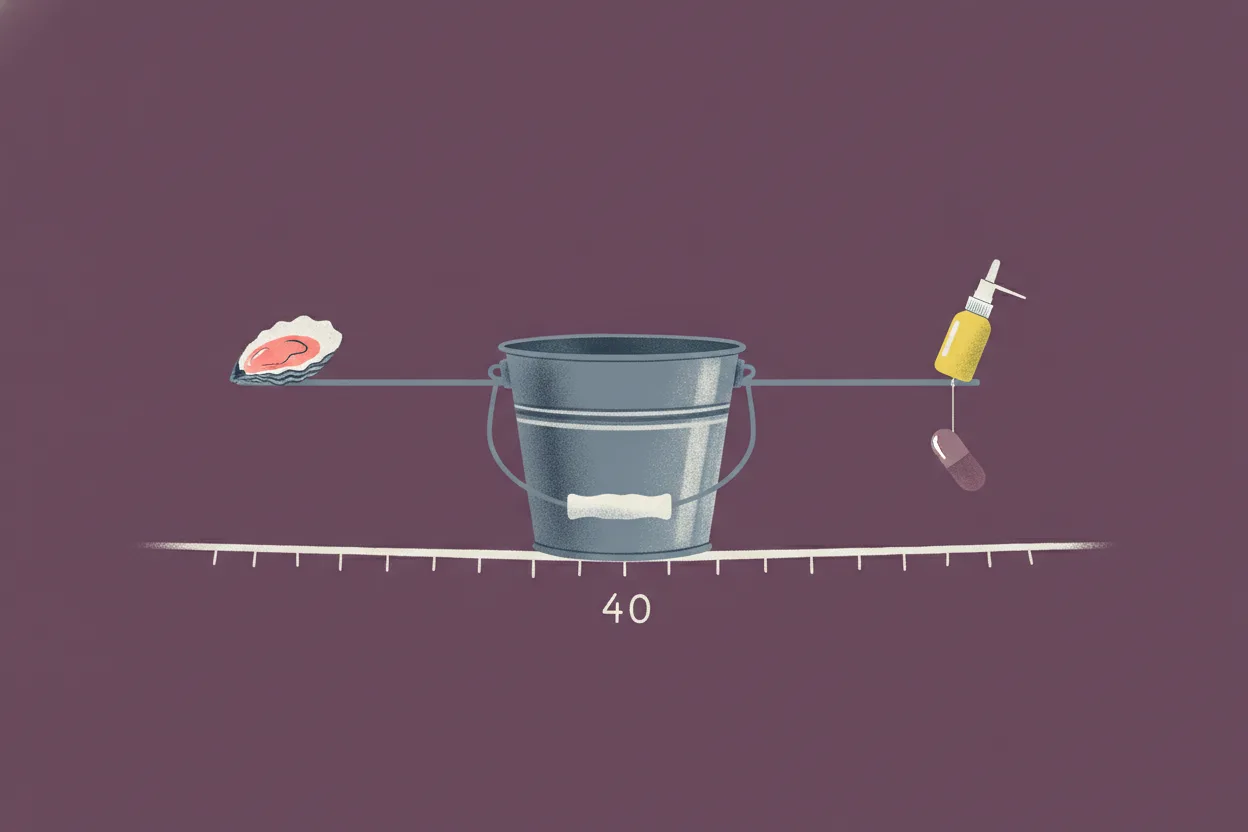
For adults, NIH's Office of Dietary Supplements sets the zinc RDA at 11 mg/day for men and 8 mg/day for women, with an upper limit of 40 mg/day. Both figures cover everything you consume: food, water, multivitamins and any dedicated zinc product. Most supplements are formulated at or below the RDA, which keeps everyday use well inside that range.
The concern, then, is not taking zinc daily. It is sustained intake above the ceiling, which usually happens by accident. A multivitamin, a cold remedy and a standalone zinc capsule each look modest on their own, but they add together. Read the Supplement Facts panel on every product you take regularly, not just the one you think of as the zinc one.
For background on what zinc does and where it comes from, see our zinc topic hub.
Common side effects at ordinary doses
The usual complaints are nausea, a metallic or bitter taste and general stomach upset. They tend to be worse on an empty stomach. Taking the dose with a meal is the standard first adjustment, and it is worth trying before deciding a supplement does not agree with you.
NIH also lists dizziness, headache, vomiting and loss of appetite among the signs of excess zinc. Diarrhea appears on that list too, but it is tied to high, acute intakes rather than a routine capsule. Constipation is not a documented zinc effect. If you are constipated on a combination product, check the label for iron.
Higher doses make GI effects more likely. A 2013 meta-analysis of zinc lozenge trials, using 75 mg/day or more for colds, found more nausea and bad taste than with placebo (PMID 23775705). A 2017 analysis of lozenge trials at 80 to 207 mg/day found no added benefit at the upper end of that range (PMID 28515951). Those doses are well above the 40 mg/day limit, and the trials were short, so they say little about long-term safety.
In children, a large Cochrane review of oral zinc for diarrhea found more vomiting than with placebo (PMID 27996088). That is one more reason to follow a pediatrician's guidance rather than scaling down an adult dose.
The copper problem
The best-documented long-term risk is not stomach upset. It is copper. Zinc and copper compete for absorption, so a steady high zinc intake can push copper status down.
A 1984 controlled study gave healthy men 50 mg/day of supplemental zinc for six weeks. Activity of a copper-dependent enzyme fell, even though plasma copper had not yet changed (PMID 6486080). That is a useful early marker, but the study was short and did not follow anyone beyond six weeks. It also does not tell us how much real-world harm follows.
The more severe end of the spectrum appears in case reports. A 2008 case series described four people who used very large amounts of zinc-containing denture cream over a long period. They developed copper deficiency and serious neurologic disease, which improved after they stopped the cream and received copper (PMID 18525032). Four patients cannot establish how common this is. It does show that zinc from non-supplement sources counts toward your total.
NIH also notes that very high, chronic zinc intake has been linked to reduced immune function, which is the opposite of what many people want from it. Many multivitamins add a small amount of copper to offset this, but that is not a license to exceed the limit.
Drug and supplement interactions
Zinc's clearest drug interaction involves antibiotics. A 2006 review confirmed that quinolone antibiotics bind zinc and other minerals in the gut, which reduces how well the antibiotic is absorbed (PMID 16556082). Tetracyclines behave similarly with minerals. The usual solution is separating the doses by several hours, but the right spacing depends on the drug, so ask your pharmacist instead of guessing.
The mineral interactions are about absorption, and the table summarizes what the studies found.
| Combination | What the evidence shows | Practical step |
|---|---|---|
| Zinc + quinolone or tetracycline antibiotic | Antibiotic absorption can drop sharply when taken together | Ask a pharmacist how to space the doses |
| Zinc + nonheme iron supplement | A 1981 trial found zinc absorption fell as the iron-to-zinc ratio rose; heme iron and iron eaten with zinc in food did not do this | Take separate supplements at different times |
| Zinc + calcium supplement | Fortified milk, calcium supplements and a single 600 mg calcium carbonate dose with a meal significantly reduced zinc absorption | Separate large calcium doses from zinc |
| High-dose zinc + copper | Sustained zinc intake lowers copper status | Stay at or under 40 mg/day from all sources |
The iron and calcium findings come from controlled trials (PMID 7223699; PMID 9174476). They concern absorption rather than harm, so the stakes are lower than with antibiotics. No established interaction exists between zinc and blood-thinning medication in the sources we reviewed, though anyone on an anticoagulant should still tell their prescriber about every supplement. For a fuller walk-through, see zinc and medications: what to check.
Who should check with a doctor first
- Kidney disease. Zinc is cleared partly by the kidneys, and impaired clearance changes how a dose behaves. Ask before adding a supplement.
- Anyone taking a quinolone or tetracycline antibiotic. Timing matters, as above.
- Anyone already getting zinc from other products. Multivitamins, cold remedies and standalone capsules all count toward the 40 mg/day limit.
- Anyone planning a high dose for weeks or months. The copper data are the reason to involve a clinician rather than sustain intake above the ceiling on your own.
- People who are pregnant or breastfeeding, and children. Zinc needs differ in pregnancy and lactation, and pediatric amounts differ from adult ones. Get individualized guidance instead of using the adult figures here.
There is also a testing point. A 2015 clinical review found the standard blood test for zinc has poor sensitivity and specificity on its own, so diagnosing deficiency takes a clinician weighing history, examination and labs (PMID 25681484). Taking extra zinc because of a suspicion of deficiency is therefore a weaker basis than it seems. For more on limits and groups to be cautious about, see who should not take zinc.
Zinc products that are not ordinary capsules
Some of the sharpest safety signals involve forms other than a swallowed supplement. A 2004 case series described severe and sometimes permanent loss of smell in patients who used intranasal zinc gluconate as a cold remedy (PMID 15283486). It was a case series, so it cannot give a rate, but the outcome was serious enough that nasal zinc is best avoided.
Lozenges deliver high daily totals, as noted above. They are intended for short use at the start of a cold, and the doses in trials exceeded the upper limit. Zinc has not been shown to help in every infection, either. In a 2021 randomized trial of 214 outpatients with confirmed COVID-19, 50 mg/day of zinc gluconate did not significantly shorten symptoms, and the trial was stopped early (PMID 33576820).
Topical zinc oxide in sunscreen or diaper cream is a separate matter. It is regulated as a skin protectant or UV filter, and the daily intake figures in this article do not apply to it. Denture cream is the exception that proves the rule: very heavy, prolonged use was the problem in the case series above.
Warning signs to stop and get advice
- Rash, hives, swelling or difficulty breathing after a dose, which may indicate an allergy to zinc or another ingredient in the product.
- Persistent vomiting, severe stomach pain or diarrhea that does not settle.
- Ongoing dizziness or headache that began after you started or raised a dose.
- New numbness, tingling, weakness or unsteadiness, especially if you have taken high doses or used zinc products for a long time. The denture cream case series involved serious neurologic disease from copper deficiency, though many other causes of these symptoms exist.
- Any reduced sense of smell after using a nasal zinc product.
Mild nausea or a metallic taste is a different category. Try taking the dose with a meal or lowering it, and if symptoms continue, ask a clinician. Recurrent GI trouble on a standard dose is more likely to come from a filler, another ingredient or an unrelated problem than from zinc itself. For how much is too much in practice, see how much zinc is too much.
Frequently asked questions
Does zinc interact with blood thinners?
The sources behind this article found no established interaction between zinc and anticoagulant medication, and zinc is not a blood thinner. That is an absence of documented evidence, not proof of safety in every case. If you take a blood thinner, tell your prescriber about every supplement so they can judge your situation.
Can zinc cause diarrhea?
Diarrhea is listed by NIH among signs of taking too much zinc, but that refers to high, acute intakes. At routine capsule doses, nausea, taste changes and stomach upset are more typical. If you get diarrhea on a standard dose, consider other ingredients or interactions and mention it to a doctor.
Is zinc oxide in sunscreen covered by the 40 mg limit?
No. The 40 mg/day upper limit applies to zinc consumed from food, water and supplements. Topical zinc oxide in sunscreen or diaper cream is regulated as a skin protectant or UV filter, so the intake figures here do not apply. Zinc-containing denture cream used heavily and for long periods is a documented exception.
How far apart should I take zinc and an antibiotic?
The exact spacing depends on which antibiotic you take, so a pharmacist or prescriber should set it. Quinolones and tetracyclines bind zinc in the gut and are absorbed less well when taken together. General practice is to separate them by hours, but do not rely on a generic rule.
Sources (11)
- Fischer PW, et al. Effect of zinc supplementation on copper status in adult man. Am J Clin Nutr. 1984.
- Nations SP, et al. Denture cream: an unusual source of excess zinc, leading to hypocupremia and neurologic disease. Neurology. 2008.
- Singh M, et al. Zinc for the common cold. Cochrane Database Syst Rev. 2013.
- Hemilä H. Zinc lozenges and the common cold: a meta-analysis comparing zinc acetate and zinc gluconate, and the role of zinc dosage. JRSM Open. 2017.
- Shakeri-Nejad K, et al. Drug interactions during therapy with three major groups of antimicrobial agents. Expert Opin Pharmacother. 2006.
- Solomons NW, et al. Studies on the bioavailability of zinc in humans: effects of heme and nonheme iron on the absorption of zinc. Am J Clin Nutr. 1981.
- Wood RJ, et al. High dietary calcium intakes reduce zinc absorption and balance in humans. Am J Clin Nutr. 1997.
- Jafek BW, et al. Anosmia after intranasal zinc gluconate use. Am J Rhinol. 2004.
- Thomas S, et al. Effect of High-Dose Zinc and Ascorbic Acid Supplementation vs Usual Care on Symptom Length and Reduction Among Ambulatory Patients With SARS-CoV-2 Infection: The COVID A to Z Randomized Clinical Trial. JAMA Netw Open. 2021.
- Lazzerini M, et al. Oral zinc for treating diarrhoea in children. Cochrane Database Syst Rev. 2016.
- Livingstone C. Zinc: physiology, deficiency, and parenteral nutrition. Nutr Clin Pract. 2015.
Adapted from research by the Electric Tiger editorial team — read the original.