Ashwagandha
Ashwagandha benefits: what human trials actually show
A claim-by-claim review of the human evidence for ashwagandha, with effect sizes where they exist and plain notes on where the research is weak, mixed or missing.
By Artifact Editors, Editorial team
Published · 6 min read
In this article
- Stress, anxiety and cortisol: a real signal with a gap
- Depression: a large average built on uneven trials
- Sleep: encouraging, but two thin trials
- Testosterone, strength and male fertility
- Menopause symptoms: the most consistent human result
- Focus, memory and ADHD
- Blood sugar, cholesterol, blood pressure and weight
- Claims without human evidence, and what safety data show
- FAQ
Stress, anxiety and cortisol: a real signal with a gap
This is where most of the research sits. In a 2012-era trial of 64 adults with chronic stress, 600 mg/day of a root extract for 60 days lowered stress scores and serum cortisol compared with placebo (PMID 23439798). A 52-person trial using the same dose for 8 weeks reported lower perceived stress and cortisol as well (PMID 27055824).
The pooled picture is less tidy. A 2014 review of five small trials found improved anxiety and stress scores, but the authors flagged bias risk in all five (PMID 25405876). A 2022 network meta-analysis agreed that anxiety scores fell versus placebo while calling the trials small and the evidence preliminary (PMID 35378276).
The most useful caveat comes from a 2025 meta-analysis of seven trials (488 participants). Cortisol fell significantly versus placebo, but a matched analysis of six trials found no significant effect on perceived stress (PMID 40746175). A 30-day, 60-person trial found a similar split: some cognitive scores and cortisol (at the lower dose only) improved, while self-reported stress and mood improved just as much on placebo (PMID 34838432).
Evidence strength: moderate for a cortisol effect, weak to mixed for how people feel. None of this establishes ashwagandha as a treatment for an anxiety disorder. More on the topic is collected on our ashwagandha topic page.
Depression: a large average built on uneven trials
A 2026 meta-analysis of 22 trials reported large average improvements in anxiety, stress and depression scores with ashwagandha (PMID 41644067). The authors described the evidence as heterogeneous and said an effective dose has not been established.
That caution matters because the trials pooled differ in population, dose and form. The one trial above built to separate mood from placebo response found no advantage for ashwagandha on self-reported mood (PMID 34838432). One pooled number is not a reason to treat it as an antidepressant alternative.
Evidence strength: weak to moderate, and not diagnosis-specific. Anyone taking an antidepressant should know that a chart review of adverse-event reports linked ashwagandha plus four different antidepressants to a range of side effects, though that design cannot prove cause (PMID 37829299).
Sleep: encouraging, but two thin trials
An 8-week placebo-controlled trial in 80 adults, half healthy and half with diagnosed insomnia, found a root extract improved several sleep measures versus placebo, with larger gains in the insomnia group. The abstract does not report the exact dose (PMID 32818573).
The second study gave 6 g/day of root powder for 4 weeks to 27 elderly men with diagnosed insomnia and reported better self-rated sleep (PMID 35370376). There was no placebo group, only comparison with their own baseline, and 6 g is several times a typical capsule serving.
Evidence strength: weak to moderate. One placebo-controlled trial of unconfirmed dose and one uncontrolled study do not tell you what a standard dose does for a typical sleeper.
Testosterone, strength and male fertility
A 2026 meta-analysis of 20 randomized trials found a small increase in testosterone and an increase in muscle strength, mainly in physically active people, with no effect on body weight or fat (PMID 42199854). The source figures put the standardized effect at about 0.33 for testosterone and 0.58 for strength. An earlier meta-analysis of 12 to 13 trials found better strength, fitness and recovery measures than placebo, with the authors noting bias risk (PMID 33670194).
Higher testosterone does not guarantee feeling better. In 57 overweight men aged 40 to 70, a low-dose standardized extract (21 mg withanolide glycosides/day) raised DHEA-S and testosterone but did not improve fatigue or vigor (PMID 30854916). In 86 men with diagnosed erectile dysfunction, 60 days of root powder did not outperform placebo (PMID 22529644).
Fertility findings come from uncontrolled work. In 60 infertile men, 5 g/day of root powder for 3 months was followed by lower stress markers and improved semen measures versus their own baseline (PMID 19789214). A 180-man study with the same dose and duration reported semen chemistry shifting toward fertile-range levels (PMID 23796876). Neither had a placebo group.
Evidence strength: moderate for a small testosterone and strength effect; weak for fertility; negative for erectile dysfunction.
Menopause symptoms: the most consistent human result
Two placebo-controlled trials point the same way. In 100 perimenopausal women, 600 mg/day of root extract for 8 weeks reduced climacteric symptom scores and improved quality of life versus placebo. Estradiol, FSH and LH shifted, testosterone did not (PMID 34553463).
In 60 women aged 45 to 55, an extract taken for 56 days reduced menopause symptom scores and hot flash events and shifted several reproductive hormones (PMID 41561822).
Evidence strength: moderate for symptom scores, limited by small samples and two similar designs. Both trials used extract, not plain root powder, and neither supports using it in place of a clinician's evaluation.
Focus, memory and ADHD
The cognition data are a mixed bag. The 2026 meta-analysis of 20 trials that found the testosterone effect also reported better memory, attention and processing-speed scores, but those are lab tests, not everyday focus (PMID 42199854). A 59-person trial of a low-dose liposomal root-and-leaf extract improved several cognitive measures and lowered tension and fatigue ratings versus placebo after a single dose and after 30 days (PMID 38931168).
For ADHD, there is one trial. In 58 children and adolescents with mild ADHD, 300 mg/day of root extract for 8 weeks improved symptom scores versus placebo, with no serious adverse events (PMID 42602386). A single, unreplicated study in a narrow group is not a basis for giving a supplement to a child. See the Electric Tiger review of the ADHD research for more detail.
Evidence strength: weak to moderate for test scores; very weak for ADHD.
Blood sugar, cholesterol, blood pressure and weight
A 2026 meta-analysis of 11 trials (667 people) found ashwagandha modestly lowered fasting glucose, by about 3 mg/dL on average. Certainty was very low, no effective dose was established, and HbA1c did not meaningfully change (PMID 42641800).
For cholesterol, a small 3-month trial in adults with high cholesterol found an ashwagandha-only arm (500 mg twice daily) improved LDL and VLDL against its own starting values. The trial also had statin and combination-supplement arms, and the ashwagandha comparison was not against placebo (PMID 42170977).
For blood pressure, the evidence is negative or inconclusive. A safety trial of 80 healthy adults on 600 mg/day for 8 weeks found no significant change (PMID 33338583). In 60 adults with hypertension and anxiety, anxiety and cortisol fell, but blood pressure was reported only as a favorable trend (PMID 42105298).
Weight appeared only as a secondary result. Adults under chronic stress taking 600 mg/day for 8 weeks had lower weight and BMI than placebo (PMID 27055824), but the 20-trial meta-analysis found no effect on body weight or fat in general (PMID 42199854).
Evidence strength: very low to weak across all four.
Claims without human evidence, and what safety data show
| Claim | Best available evidence | Strength |
|---|---|---|
| Asthma | A review calls lung-function effects "significant but inconsistent" without details (PMID 42582728); a mouse study used an isolated compound (PMID 40451110) | Very weak |
| Cancer | A phase 1 safety trial of a leaf-extract drug in lung cancer (PMID 41685666); a non-randomized chemotherapy study with fatigue benefit and no significant survival difference (PMID 23142798) | Very weak |
| Gut disease | Preclinical mention in an IBD review (PMID 38716550) | No human data |
| Seizures, Parkinson's | Reviews citing theory or mouse models (PMID 39069797, 42356373) | No human data |
| Skin conditions | A mouse study of a seed extract (PMID 31991752) | No human data |
| Hair | One manufacturer-funded trial, 600 mg/day for 75 days, in people reporting hair or skin concerns (PMID 41770039) | Weak |
| Joint pain | A network meta-analysis found improved stiffness scores but no top ranking for pain or function (PMID 41126953) | Weak |
On safety, a 2026 review of 23 trials (2,317 people) found standardized root extract at 125 to 600 mg/day generally well tolerated, with mild stomach discomfort, headache and drowsiness reported infrequently and about as often on placebo (PMID 42198398). A review of 30 trials reported no serious adverse events (PMID 32201301).
Case reports temper that. Liver injury judged probably related to ashwagandha has been reported at 1,350 mg/day for 6 months and at 450 mg for 45 days, resolving after stopping (PMID 37631044), and in a healthy 22-year-old within 30 hours of starting (PMID 39553154). Case reports cannot show how common this is. A placebo-controlled trial also found an extract shifted thyroid hormones in people with subclinical hypothyroidism (PMID 28829155), which is why thyroid conditions call for a doctor's input.
Frequently asked questions
Is root powder as well studied as extract?
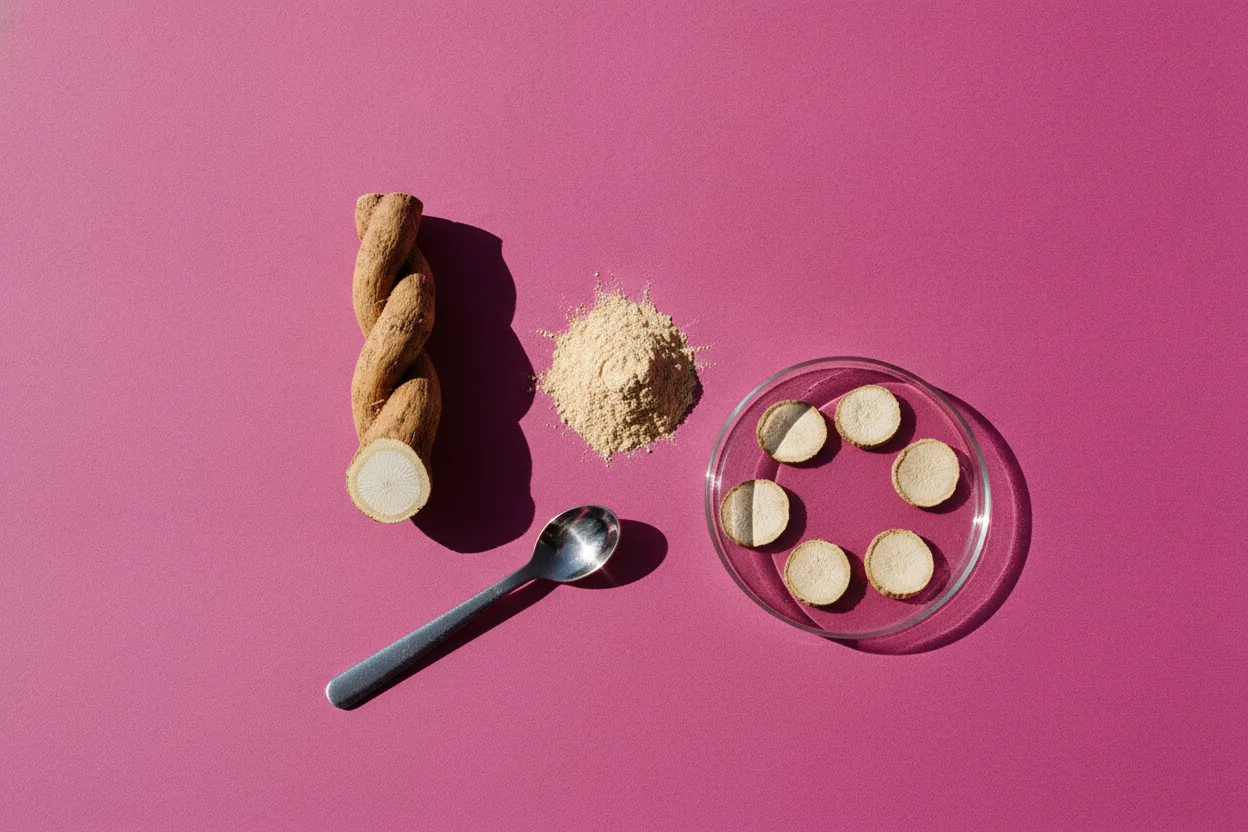
No. Most placebo-controlled trials used concentrated extracts at about 125 to 600 mg/day. The root-powder studies mostly used 5 to 6 g/day, often without a placebo group, in specific groups such as infertile men or elderly men with insomnia. Results from one form do not transfer cleanly to the other.
Does ashwagandha help with weight loss?
The evidence does not support it as a weight-loss aid. One 8-week trial in stressed adults found lower body weight and BMI than placebo as a secondary result. A 2026 meta-analysis of 20 trials found no effect on body weight or fat overall.
How long do the trials run?
Most run 4 to 12 weeks: 30 days for the cognition trials, 8 weeks for menopause and sleep, 60 days for the chronic-stress trial, and 12 weeks for the schizophrenia add-on trial. Long-term effects and safety beyond a few months are not well characterized.
Can I take ashwagandha with antidepressants?
Talk to a prescriber first. A chart review linked ashwagandha combined with four antidepressants to side effects ranging from digestive symptoms to muscle and eye problems, attributed to additive effects and drug-metabolism interactions. That design cannot prove cause, but it is a reason for caution.
Sources (40)
- Chandrasekhar K, et al. A prospective, randomized double-blind, placebo-controlled study of safety and efficacy of a high-concentration full-spectrum extract of ashwagandha root in reducing stress and anxiety in adults. Indian J Psychol Med. 2012.
- Choudhary D, et al. Body Weight Management in Adults Under Chronic Stress Through Treatment With Ashwagandha Root Extract: A Double-Blind, Randomized, Placebo-Controlled Trial. J Evid Based Complementary Altern Med. 2017.
- Pratte MA, et al. An alternative treatment for anxiety: a systematic review of human trial results reported for the Ayurvedic herb ashwagandha (Withania somnifera). J Altern Complement Med. 2014.
- Zhang W, et al. Medicinal herbs for the treatment of anxiety: A systematic review and network meta-analysis. Pharmacol Res. 2022.
- Albalawi AA. Dual impact of Ashwagandha: Significant cortisol reduction but no effects on perceived stress - A systematic review and meta-analysis. Nutr Health. 2025.
- Remenapp A, et al. Efficacy of Withania somnifera supplementation on adult's cognition and mood. J Ayurveda Integr Med. 2022.
- Alsanie SA, et al. Effects of ashwagandha (Withania somnifera) on mental health in adults: A systematic review and dose-response meta-analysis of randomized controlled trials. Complement Ther Med. 2026.
- Siwek M, et al. Harder, better, faster, stronger? Retrospective chart review of adverse events of interactions between adaptogens and antidepressant drugs. Front Pharmacol. 2023.
- Langade D, et al. Clinical evaluation of the pharmacological impact of ashwagandha root extract on sleep in healthy volunteers and insomnia patients: A double-blind, randomized, parallel-group, placebo-controlled study. J Ethnopharmacol. 2021.
- Atul U, et al. Efficacy of Brimhana Nasya and Ashwagandha (Withania somnifera (L.) Dunal) root powder in primary insomnia in elderly male: A randomized open-label clinical study. Ayu. 2020.
- Zhu X, et al. Effects of Withania somnifera (L.) Dunal (Ashwagandha) on cognitive and physical function in adults: a systematic review and meta-analysis. Front Pharmacol. 2026.
- Bonilla DA, et al. Effects of Ashwagandha (Withania somnifera) on Physical Performance: Systematic Review and Bayesian Meta-Analysis. J Funct Morphol Kinesiol. 2021.
- Lopresti AL, et al. A Randomized, Double-Blind, Placebo-Controlled, Crossover Study Examining the Hormonal and Vitality Effects of Ashwagandha ( Withania somnifera) in Aging, Overweight Males. Am J Mens Health. 2019.
- Mamidi P, et al. Efficacy of Ashwagandha (Withania somnifera Dunal. Linn.) in the management of psychogenic erectile dysfunction. Ayu. 2011.
- Mahdi AA, et al. Withania somnifera Improves Semen Quality in Stress-Related Male Fertility. Evid Based Complement Alternat Med. 2011.
- Gupta A, et al. Efficacy of Withania somnifera on seminal plasma metabolites of infertile males: a proton NMR study at 800 MHz. J Ethnopharmacol. 2013.
- Gopal S, et al. Effect of an ashwagandha (Withania Somnifera) root extract on climacteric symptoms in women during perimenopause: A randomized, double-blind, placebo-controlled study. J Obstet Gynaecol Res. 2021.
- Vani I, et al. A prospective, randomized, double-blind, placebo-controlled study on efficacy and safety of Ashwagandha root extract (Withania somnifera) for managing menopausal symptoms in women. Front Reprod Health. 2025.
- Leonard M, et al. Acute and Repeated Ashwagandha Supplementation Improves Markers of Cognitive Function and Mood. Nutrients. 2024.
- Naik S, et al. Efficacy and safety of ashwagandha root extract in children and adolescents with mild attention-deficit/hyperactivity disorder: a randomized, double-blind, placebo-controlled trial. J Med Life. 2026.
- Farrin N, et al. The effects of Ashwagandha (Withania somnifera) supplementation on fasting blood glucose and HbA1c: a systematic review and dose-response meta-analysis of randomized controlled trials. Diabetes Res Clin Pract. 2026.
- Zubair K, et al. Combined effect of Withania somnifera and Syzygium cumini on hyperlipidemic patients. Pak J Pharm Sci. 2026.
- Verma N, et al. Safety of Ashwagandha Root Extract: A Randomized, Placebo-Controlled, study in Healthy Volunteers. Complement Ther Med. 2021.
- Pattojoshi A, et al. Safety and efficacy of ashwagen (a standardized withania somnifera extract) in stress and anxiety with hypertension and associated cardiometabolic risk factors: a randomized, placebo-controlled trial. Stress. 2026.
- Al Obaidi G, et al. Beyond Conventional Treatment: Herbal Medicine and Nutraceuticals as Complementary Therapies for COPD and Asthma. Open Respir Med J. 2026.
- Agner K, et al. Withaferin A reduces pulmonary eosinophilia and IL-25 production in a mouse model of allergic airways disease. J Ayurveda Integr Med. 2025.
- Heo JU, et al. Phase 1 Trial of Withania somnifera Leaf Extract (RH324) in Advanced Non-Small Cell Lung Cancer Including [(18)F]FDG PET/CT as a Short-Term Metabolic Biomarker to Assess Efficacy: A Novel Model for Assessment of Complimentary Therapies in Early Phase Human Clinical Trials. Integr Cancer Ther. 2026.
- Biswal BM, et al. Effect of Withania somnifera (Ashwagandha) on the development of chemotherapy-induced fatigue and quality of life in breast cancer patients. Integr Cancer Ther. 2013.
- Joshi M, et al. Emerging Natural Therapies for the Treatment of Inflammatory Bowel Disease. Curr Pharm Biotechnol. 2025.
- Anand A, et al. Neuroprotective Efficacy and Complementary Treatment with Medicinal Herbs: A Comprehensive Review of Recent Therapeutic Approaches in Epilepsy Management. CNS Neurol Disord Drug Targets. 2025.
- Dube K, et al. Curcumin, Coenzyme-Q10, and Bioactive Compounds in Ashwagandha Extract: Multi-Targeting Potential of Co-Administered Natural Health Compounds as Therapeutic and Preventative Interventions in Alzheimer's and Parkinson's Disease Models. Nutrients. 2026.
- Balkrishna A, et al. Super Critical Fluid Extracted Fatty Acids from Withania somnifera Seeds Repair Psoriasis-Like Skin Lesions and Attenuate Pro-Inflammatory Cytokines (TNF-α and IL-6) Release. Biomolecules. 2020.
- Jillella A, et al. A Prospective, Randomized, Double-Blind, Placebo-Controlled Clinical Study of Efficacy and Safety of Ashwagandha Root Extract Capsule on Skin and Hair Health in Healthy Adults. Phytother Res. 2026.
- Yan C, et al. Efficacy of botanical extracts for knee osteoarthritis: a network meta-analysis of randomized controlled trials. Front Pharmacol. 2025.
- Coope OC, et al. Back to the Roots: Safety and Tolerability of Standardised Ashwagandha (Withania somnifera) Root Extract in Healthy Adults-A Systematic Review of Biomarkers and Adverse Events. Pharmaceuticals (Basel). 2026.
- Tandon N, et al. Safety and clinical effectiveness of Withania Somnifera (Linn.) Dunal root in human ailments. J Ethnopharmacol. 2020.
- Bokan G, et al. Herb-Induced Liver Injury by Ayurvedic Ashwagandha as Assessed for Causality by the Updated RUCAM: An Emerging Cause. Pharmaceuticals (Basel). 2023.
- Almuzghi F, et al. Ashwagandha-Induced Hepatic Injury: A Case Report. Cureus. 2024.
- Sharma AK, et al. Efficacy and Safety of Ashwagandha Root Extract in Subclinical Hypothyroid Patients: A Double-Blind, Randomized Placebo-Controlled Trial. J Altern Complement Med. 2018.
- Zellner L, et al. Determination of Withanolides and Withanosides in Ashwagandha Based Products Using HPLC-Drift-Tube-Ion-Mobility Quadrupole Time-of-Flight Mass Spectrometry. Electrophoresis. 2025.
Adapted from research by the Electric Tiger editorial team — read the original.