Niacinamide
Niacinamide versus hyaluronic acid: which works better?
No head-to-head trial has compared the two. Here is what the research does show about each, and why the combination serums muddy the picture.

By Artifact Editors, Editorial team
Published · 3 min read
In this article
The short answer: the head-to-head evidence doesn't exist yet
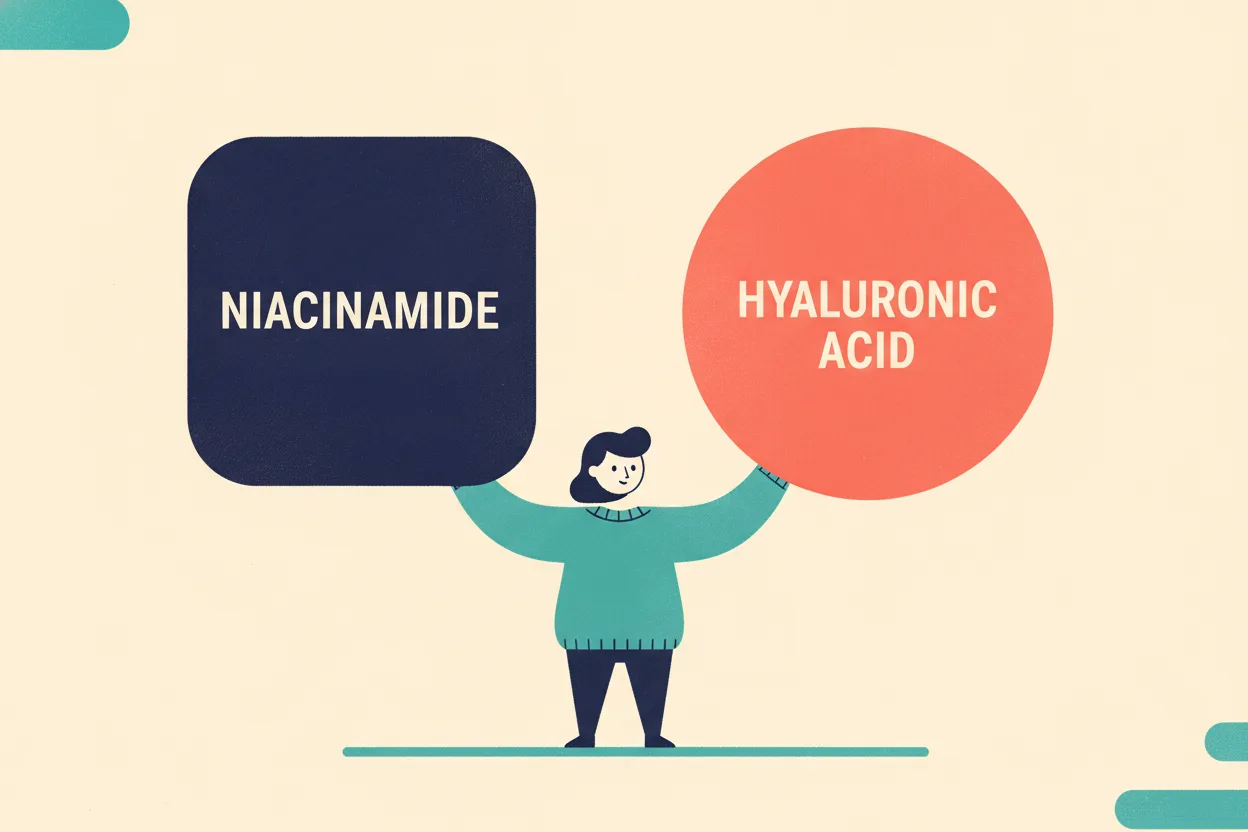
We searched for a trial pitting topical niacinamide against hyaluronic acid (HA) and found none. The honest answer to which works better is that the evidence isn't there yet. What we found instead were three other kinds of study: niacinamide against hydroquinone, niacinamide and HA combined in one product, and injectable HA.
Niacinamide has the more direct evidence, though it is thin in spots
For skin-aging appearance, niacinamide is the better-studied ingredient on its own. A dermatology review found reductions in fine lines, wrinkles, hyperpigmented spots, red blotchiness and yellowing, plus better elasticity, across several clinical studies (dermatology review on aging skin). A later mechanistic review called it well tolerated but found no convincing evidence for one specific molecular target (mechanistic review of aging and pigmentation).
- Melasma: in a 2011 split-face trial of 27 women over eight weeks, colorimetric measures did not differ between sides, and good-to-excellent improvement was 44% with 4% niacinamide versus 55% with 4% hydroquinone (melasma split-face trial). The sample is small and the trial is old.
- Sebum: clinical use clusters around 2–5%, and 2–4% products reportedly worked better in oily skin (mechanistic insights review).
- Acne: a systematic review cites one 41-person trial where niacinamide reduced sebum, but it reports no clinical acne outcome from that trial (acne treatment review).
On safety, the reviews describe topical niacinamide as well tolerated. We did not find a dedicated safety trial with adverse-event rates, so that claim rests on review-level summaries.
Hyaluronic acid's evidence here is mostly injectable
The HA studies we found are mostly injectables or devices, which are not like-for-like with a topical serum. One multicenter, assessor-blinded trial tested injectable non-crosslinked HA for facial rejuvenation (injectable HA rejuvenation trial). That tells you about clinic treatments, not what a serum does at home.
We found no topical HA trial in this search, and we did not research HA penetration or molecular weight. We can't make claims about how HA behaves on skin from this material.
Combination products make the comparison harder
Most of the HA evidence tests HA and niacinamide together. A topical serum with both, studied in 44 women over two months, reported skin smoothness up 39% and fine-line intensity down 15% (niacinamide and HA serum study). There was no niacinamide-only or HA-only arm, so those gains can't be credited to either ingredient.
Injectable combinations show the same gap. A hydrogel with HA, niacinamide and tranexamic acid reported better hydration, texture, elasticity and pigmentation in 49 women over 70 days, with no serious adverse events (injectable hydrogel study). A separate device report used HA and niacinamide together as well (device report). Neither study isolated one ingredient.
| Study | Design | Main limit |
|---|---|---|
| Niacinamide vs. hydroquinone (melasma) | Split-face RCT, 27 women | Small, dated 2011, no HA arm |
| Niacinamide plus HA serum | 44 women, 2 months | No single-ingredient control |
| HA, niacinamide and tranexamic acid hydrogel | Injectable, 49 women, 70 days | Injectable, no single-ingredient control |
| HA and niacinamide device | Injectable, 43 enrolled, 42 completed | Device report, no single-ingredient control |
How to choose between them
Check the concentration on the label, since clinical niacinamide work clusters around 2–5%. For background on the ingredient itself, see our niacinamide guide. Choose based on your skin goal and how your skin reacts over several weeks.
Frequently asked questions
Can you use niacinamide and hyaluronic acid together?
We didn't find a trial that tested layering them, so the research can't tell you how they interact. The combination serums studied tested both ingredients together in one formula, not against either one alone.
Which is better for dry skin?
No study we found compares the two for dryness, so no ranking exists for dry skin. The niacinamide studies measured aging appearance, pigmentation and sebum, and the HA studies were mostly injectable.
Sources (9)
- Bogdanowicz et al., "Senomorphic activity of a combination of niacinamide and hyaluronic acid: correlation with clinical improvement of skin aging"
- Navarrete-Solís et al., "A Double-Blind, Randomized Clinical Trial of Niacinamide 4% versus Hydroquinone 4% in the Treatment of Melasma" 2011
- "Mechanistic Basis and Clinical Evidence for the Applications of Nicotinamide Niacinamide to Control Skin Aging and Pigmentation"
- "Niacinamide: A B vitamin that improves aging facial skin appearance" PubMed 16029679
- "Efficacy of Topical Treatments in the Management of Mild-to-Moderate Acne Vulgaris: A Systematic Review"
- "Mechanistic Insights into the Multiple Functions of Niacinamide: Therapeutic Implications and Cosmeceutical Applications in Functional Skincare Products"
- "Clinical Safety and Efficacy of Hyaluronic Acid–Niacinamide–Tranexamic Acid Injectable Hydrogel for Multifactorial Facial Skin Quality Enhancement with Dark Skin Lightening"
- "An Injectable Biopolymer Hydrogel Complex PN/HA/B3 for Facial Skin Redensification and General Rejuvenation: Clinical Report on Device Safety and Efficacy"
- "A Prospective, Multicenter, Randomized, Assessor-Blinded Study Assessing the Efficacy and Safety of Injectable Non-Cross-Linked Hyaluronic Acid for Improving Facial Skin Rejuvenation"