Magnesium baths
What does a magnesium bath actually do for you?
Warm water and downtime explain most of the appeal; the idea that magnesium soaks through your skin is unproven, and trial evidence for sore muscles and sleep is thin.

By Artifact Editors, Editorial team
Published · 6 min read
In this article
- What is a magnesium bath, and what are the salts?
- How do magnesium bath salts work, and how much gets absorbed?
- Are magnesium bath salts effective for sore muscles?
- Can a magnesium bath help you sleep?
- Can a magnesium bath help constipation?
- Is a magnesium bath a substitute for a supplement or food?
- Why do people say a magnesium bath is good for you?
- Are magnesium bath soaks good for you? Who should check first
- FAQ
What is a magnesium bath, and what are the salts?
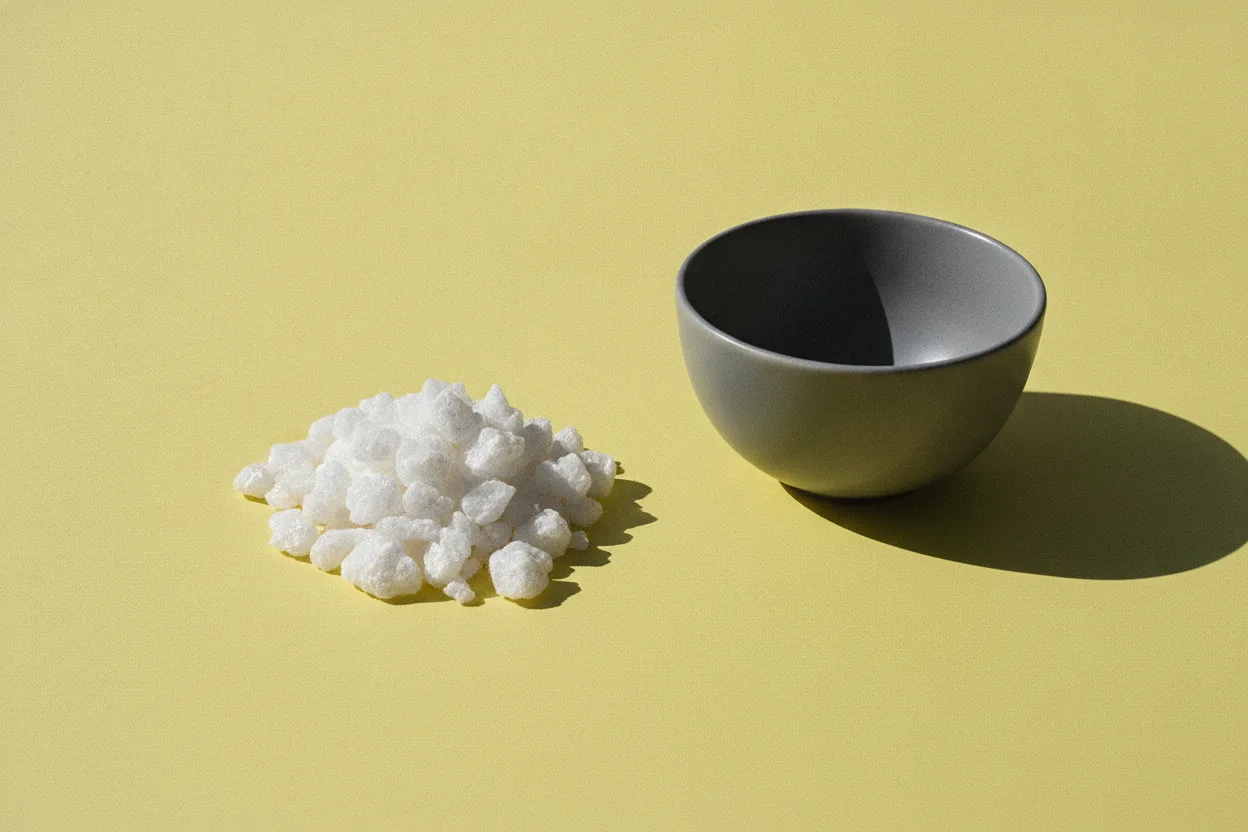
A magnesium bath is a warm bath with a magnesium salt dissolved in it. The salts are the product, and the soak is the activity.
Most products are Epsom salt, which is magnesium sulfate. Others use magnesium chloride flakes. A 2017 critical review lists magnesium salt baths and flakes among transdermal products marketed as alternatives to oral magnesium.
Epsom salt is sold over the counter as a drug-type product. Mayo Clinic's monograph lists it as a soaking solution for minor sprains, bruises, muscle aches, joint stiffness and tired feet, at 2 cups dissolved in 1 gallon of warm water. That is a labeled use, not proof of benefit.
One Epsom salt label lists 495 mg of magnesium per teaspoon (5 g), which works out to about 99 mg per gram by our arithmetic. That tells you how much magnesium is in the water. It says nothing about how much reaches your body.
How do magnesium bath salts work, and how much gets absorbed?
The headline claim, that magnesium passes through your skin and bypasses your gut, is unsupported. The same 2017 review evaluated baths, sprays and flakes and concluded that the promotion of transdermal magnesium is scientifically unsupported. It named intensive marketing, not data, as what drove the trend.
Be fair to the limits here: that review is a critical narrative review, not a systematic review or meta-analysis. But we also found no contrary trials in what we could search.
As for how much magnesium is absorbed in an Epsom salt bath, we found no high-quality human data that gives a milligram figure. Wellness articles often quote small studies with specific numbers. We did not verify those, so treat any figure as unconfirmed until you see the primary paper.
Are magnesium bath salts effective for sore muscles?
A warm soak may feel good on tired muscles, but we found no bath trial showing magnesium adds anything. Mayo's listing of muscle aches is a labeled use, not trial evidence.
The closest high-grade evidence is about oral magnesium and cramps, not baths and soreness. A 2020 Cochrane review included oral magnesium trials and one using slow intravenous infusions. No trial used a bath.
In older adults with idiopathic cramps, magnesium did not beat placebo. The share of people with at least a 25% drop in cramps was essentially the same (RR 1.04, 95% CI 0.84 to 1.29; 3 studies, 177 participants; high-certainty evidence). The authors consider clinically meaningful cramp prevention unlikely. For pregnancy-related cramps, results were conflicting and the trials were at high risk of bias.
Treat that as a reason for caution, not a verdict on baths. It concerns cramps, not post-workout soreness. Warm water plausibly relaxes muscles, but we did not retrieve a source on that, so we will not put a number on it.
Can a magnesium bath help you sleep?
Magnesium specifically is not shown to help: the warm water and timing have better support than the magnesium. We found no Epsom salt sleep trial.
The Sleep Foundation summarizes a meta-analysis of 17 studies finding that a bath or shower at roughly 104 to 108.5°F improved sleep quality. People who bathed one to two hours before bed also fell asleep faster. We saw this secondhand and could not check effect sizes, so we are not quoting any.
The proposed mechanism is simple. Warm water pulls blood toward your hands and feet, so your core temperature drops faster afterward, which helps you drift off.
Magnesium for sleep is thin, and it is oral evidence. NIH's NCCIH says there is very little research on magnesium for insomnia. A 2021 review of 3 studies (151 participants) hinted at faster sleep onset in older adults, but the reviewers called the studies low quality. A 2022 review of 9 studies (7,582 participants) found conflicting results.
Can a magnesium bath help constipation?
No evidence says it can. Epsom salt is a laxative when swallowed, not when you sit in it.
Mayo's laxative directions are oral, and its monograph does not present baths as a constipation treatment. The effect is osmotic and happens in the gut, where magnesium sulfate is poorly absorbed. A review of magnesium-sulfate-rich mineral waters calls the laxative effect widely demonstrated, though clinical studies in functional constipation only appeared this century.
Is a magnesium bath a substitute for a supplement or food?
No. Food is the primary source of magnesium, and no evidence shows a bath can supply amounts comparable to it.
The adult RDA is 310 to 420 mg a day, and roughly 30 to 40% of dietary magnesium is typically absorbed. Some practical benchmarks:
- Pumpkin seeds: 156 mg per ounce
- Almonds: 80 mg per ounce
- Boiled spinach: 78 mg per half cup
Symptomatic deficiency is uncommon in healthy people. Those at higher risk include people with GI diseases, type 2 diabetes or alcohol dependence, and older adults. NHANES 2013 to 2016 data suggest 48% of Americans take in less magnesium than their estimated average requirement.
If you suspect low intake, diet and oral supplements are the studied routes, not baths. Keep supplements under the 350 mg daily upper limit for supplements and medicines, since higher doses can cause diarrhea, nausea and cramping.
Why do people say a magnesium bath is good for you?
Mostly because a warm bath is pleasant, magnesium has a good reputation, and the marketing is loud.
- Warm water and ritual. Heat, quiet and a set-aside hour are plausible contributors, and the warm-bath sleep effect has some meta-analytic support.
- Magnesium's halo. It is a real nutrient and a cofactor in more than 300 enzyme systems. Evidence for eating it does not show that bath magnesium reaches your body.
- Marketing. The 2017 review identified intensive marketing as the driver of the transdermal trend.
There is one bath-specific study worth knowing about, with heavy caveats. A small trial in 104 cancer patients reported that Epsom salt foot baths delayed chemotherapy-induced neuropathy. We read only the abstract, don't know how well it was controlled, and a chemotherapy population tells you little about healthy people. Treat it as a hypothesis.
Are magnesium bath soaks good for you? Who should check first
For most healthy adults, a warm soak is low-risk and pleasant. Just don't expect it to deliver magnesium or treat anything.
Mayo Clinic's precautions are specific: skip the soaking solution if you are pregnant or diabetic unless a doctor says otherwise, and use caution with kidney disease because magnesium clears more slowly. Stop and call a doctor if skin irritation or infection develops. Skin infection after soaking is listed among its side effects.
Mayo does not specify a bath temperature. We found no American Academy of Dermatology, sleep medicine, ACOG or FDA statement specifically on magnesium baths. For more on the topic, see our magnesium baths hub.
Frequently asked questions
Is Epsom salt the same as magnesium bath salts?
Often, yes. Most magnesium bath salts are Epsom salt, which is magnesium sulfate. Some brands use magnesium chloride flakes instead. We found no evidence that either form is better, and the 2017 review that judged transdermal magnesium unsupported covered baths and flakes alike.
How long should you soak in an Epsom salt bath?
We found no trial-based answer. Mayo Clinic's monograph describes a soak of 2 cups dissolved in 1 gallon of warm water and a compress applied for 30 minutes, up to 3 times a day. It does not give a full-bath protocol, so follow your product label.
Do magnesium flakes work better than Epsom salt?
There is no evidence they do. Gröber's review lists magnesium salt baths and magnesium flakes together among transdermal products and found the promotion of them unsupported. We found no head-to-head human trial comparing the two for absorption, sleep or muscle soreness.
Who should avoid an Epsom salt soak?
Mayo Clinic says not to use the soaking solution if you are pregnant or diabetic unless a doctor approves, and to use caution with kidney disease because magnesium is cleared more slowly. Stop and call a doctor if you get skin irritation or signs of infection.
Sources (11)
- Myth or Reality—Transdermal Magnesium? Gröber et al., Nutrients 2017
- Magnesium sulfate oral route, topical application route — Mayo Clinic
- DailyMed – EPSOM SALT magnesium sulfate granule, for solution
- Magnesium – Health Professional Fact Sheet NIH Office of Dietary Supplements
- Magnesium for skeletal muscle cramps Garrison et al., Cochrane 2020, full text
- Showering Before Bed: Can It Help You Sleep Better? Sleep Foundation; secondary summary of Haghayegh 2019
- Sleep Disorders and Complementary Health Approaches NIH NCCIH
- Magnesium Sulfate-Rich Natural Mineral Waters in the Treatment of Functional Constipation – A Review Nutrients
- Magnesium Intoxication: Absorption from the Intact Gastrointestinal Tract Stevens & Wolff, Arch Neurol Psychiatry 1950; abstract
- Case report: Near-fatal hypermagnesemia resulting from the use of Epsom salts in a patient with normal renal function Front Med 2024
- Epsom Salt Foot Bath in Preventing or Delaying Chemotherapy-induced Neurological Manifestations RCT, abstract only