Magnesium baths
Magnesium flakes vs. Epsom salts: which is better for a bath?
Flakes are magnesium chloride and Epsom salt is magnesium sulfate. Here is what that difference means for your skin, your bath and your wallet.

By Artifact Editors, Editorial team
Published · 6 min read
In this article
- Are magnesium flakes the same as Epsom salt?
- Which magnesium is best for a bath?
- Is magnesium chloride absorbed better through skin than magnesium sulfate?
- Are magnesium bath flakes good for you?
- Do flakes feel different on the skin than Epsom salt?
- How do the two compare on price per bath?
- What should you look for on the ingredient label?
- FAQ
Are magnesium flakes the same as Epsom salt?
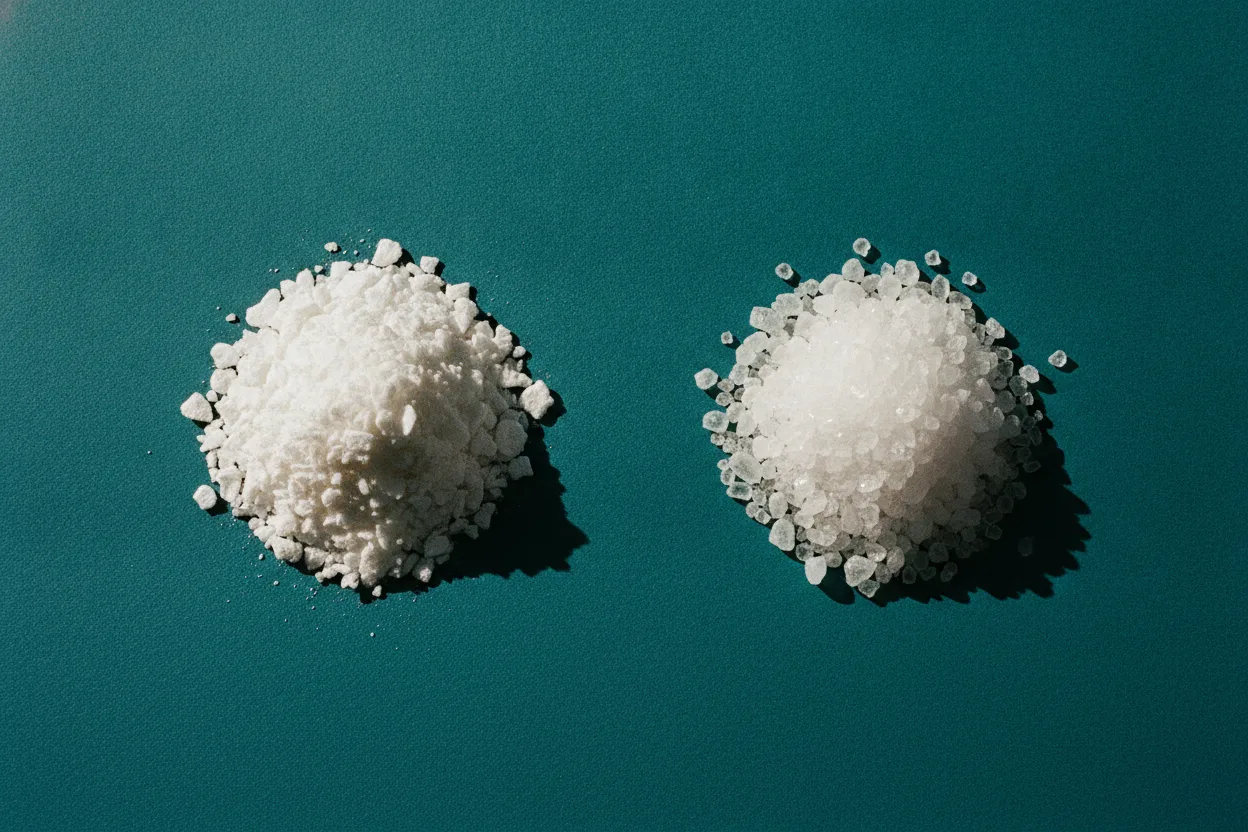
No. Epsom salt is magnesium sulfate. Flakes are magnesium chloride, usually sold as the hexahydrate. Same metal, different partner ion, different crystal.
Cleveland Clinic describes Epsom salt as a naturally occurring mineral salt made of magnesium and sulfate. In the US, plain Epsom salt is sold as an over-the-counter drug. One Epsom salt label lists magnesium sulfate heptahydrate as the 100% active ingredient, with uses as a laxative and as an external soaking aid for temporary relief of minor sprains and bruises.
We didn't find an equivalent drug category for bath flakes. They are typically sold as bath or cosmetic products, though we didn't confirm that for any specific brand.
Are magnesium bath salts the same as Epsom salt? Not necessarily. 'Magnesium bath salts' isn't a defined term. It can mean Epsom salt, flakes, or a blend with other minerals, so the ingredient list is the only thing that settles it.
| Epsom salt | Magnesium flakes | |
|---|---|---|
| Compound | Magnesium sulfate (heptahydrate) | Magnesium chloride (usually hexahydrate) |
| Magnesium by weight | About 9.9%, in line with labels listing 495 mg per 5 g | About 12% by our calculation |
| US labeling | OTC drug with Drug Facts | Typically a bath or cosmetic product (unconfirmed) |
| Bath trials | None we found showing benefit | None we found comparing it to Epsom salt |
The percentages for Epsom salt come from retail label data. The flake figure is our own arithmetic from molar mass, so it is an estimate. It works out to roughly 20% more magnesium per gram of flakes, which is real but modest.
Which magnesium is best for a bath?
No evidence we found identifies either one as superior. The research on both is thin, and the best review in the category is openly skeptical.
A 2017 narrative review in Nutrients evaluated the transdermal magnesium literature and concluded that promoting it is scientifically unsupported. It explicitly covered sprays, flakes and salt baths. It is a narrative review rather than a systematic one, but we found nothing stronger arguing the opposite.
Cleveland Clinic lands in a similar place for Epsom salt: no clinical trials have confirmed its benefits. It also calls the practice 'pretty simple and light in risk,' which is a fair summary of the situation.
Heat may be doing more of the work than the mineral. In one study of athletes, a hot-water immersion comparison found similar body-mass loss in plain hot water and in water with about 1.6% Epsom salt. The result is narrow, but it says only that body-mass loss was similar in both conditions, and that measure concerned athletes cutting weight, not skin or wellness benefits.
So pick on price, label clarity and how your skin tolerates it.
Is magnesium chloride absorbed better through skin than magnesium sulfate?
There's no evidence that it is. We found no study that compares the two directly.
The claim lives mostly in marketing and forums. A Mayo Clinic Connect thread includes a user asserting chloride is 'more readily absorbed.' That is an unsourced comment, not evidence, and we cite it only as an example of the claim.
The closest human data is a small pilot trial of magnesium cream, not a bath. It had 25 people using 56 mg a day for two weeks. Serum magnesium rose from 0.82 to 0.89 mmol/L in the magnesium group, against 0.77 to 0.79 on placebo.
That overall difference wasn't statistically significant (p=0.29). It reached significance only in a post-hoc subgroup of non-athletes, and urinary magnesium didn't change significantly. Treat it as a hint at best, and note it tested neither flakes nor Epsom salt.
A feasibility study of magnesium chloride spray in fibromyalgia enrolled 40 women, with no control group and questionnaire outcomes. It can't tell us whether magnesium got into the body at all.
Are magnesium bath flakes good for you?
They're a pleasant, low-risk soak for most healthy adults. Health benefits beyond that are unproven.
The best skin evidence is a forearm study in atopic dry skin. Volunteers soaked one forearm for 15 minutes in a 5% solution of a magnesium-chloride-rich Dead Sea salt and the other in tap water. The salted arm showed better hydration and less roughness and redness, plus better barrier function in people with high baseline water loss.
Don't stretch that too far. The salt was a branded Dead Sea product with other minerals, and the design can't show that magnesium, or chloride rather than sulfate, was responsible. Any salt solution, or the soak itself, might contribute.
For sleep, mood, muscle soreness or 'detox,' we found no bath trials of either compound. That makes those claims unproven, not disproven. One retail Epsom label even says sulfate 'helps flush toxins from proteins in joints,' and we found no evidence for that.
For more on the category, see our magnesium baths hub.
Do flakes feel different on the skin than Epsom salt?
Possibly, but we found no controlled comparison, so any difference in feel is anecdote.
You'll see claims that flakes feel silky or slightly oily while Epsom salt feels drying. Those come from user reviews, not measurements. The only objective data, the Dead Sea forearm study, tested a magnesium-chloride-rich salt in atopic skin and never compared it with Epsom salt.
One practical note from general chemistry, not a study: magnesium chloride readily takes up moisture, so flakes can clump in a humid bathroom. Epsom crystals stay looser. That affects storage, not your skin.
If you want to know for yourself, run your own test: one bath of each, a week apart, same water temperature.
How do the two compare on price per bath?
We expect Epsom salt to be cheaper per bath, but we didn't gather current retail prices, so run the numbers on what you actually see on the shelf.
Epsom salt is generally sold as an inexpensive commodity in large bags, though we did not verify a price claim from Cleveland Clinic, and it's sold as a commodity in big bags. Flakes are usually a specialty bath product. Here is how to check.
- Cost per bath = (package price ÷ package weight in grams) × grams used per bath.
- Dose: one Epsom label says to add two cups to warm bath water and soak for 20 minutes. Weigh two cups on a kitchen scale to get your grams. For flakes, use the dose on that product's label.
- Cost per gram of magnesium: divide cost per bath by the magnesium in that dose. Use about 9.9% for Epsom salt, and the stated content on the flake label.
The gram-of-magnesium math is the fairer test. Because flakes carry only about 20% more magnesium per gram by our estimate, a flake bag would need to be priced close to Epsom salt to come out ahead.
What should you look for on the ingredient label?
Start with the compound name, then check the extras and the claims.
- Compound: 'magnesium sulfate (heptahydrate)' means Epsom salt. 'Magnesium chloride (hexahydrate)' means flakes.
- Drug Facts panel: a USP-grade Epsom salt has one. A product without it is not necessarily worse, but it is regulated differently.
- Additives: plain Epsom labels we reviewed list no inactive ingredients. Fragrance and dyes in scented blends are the more likely source of irritation.
- Magnesium amount: Epsom labels give about 495 mg of magnesium per teaspoon (5 g). Compare magnesium per gram, not package weight.
- Claims: the Epsom Drug Facts uses are sprains, bruises and constipation. Detox, sleep and deficiency-correction language goes beyond both the label and the evidence.
- Internal-use warnings: Epsom salt is labeled as a laxative when taken orally. Flakes sold for baths generally aren't meant to be swallowed, so read the directions.
Frequently asked questions
Are magnesium bath salts the same as Epsom salts?
Not always. 'Magnesium bath salts' has no set definition. It can mean Epsom salt (magnesium sulfate), magnesium chloride flakes, or a mix with other minerals, fragrance and dyes. Check the ingredient list for the actual compound rather than trusting the front-of-package name.
Can a magnesium bath fix a magnesium deficiency?
There's no good evidence it can. A 2017 review called the promotion of transdermal magnesium scientifically unsupported, and We found no source showing that enough magnesium is absorbed through skin to address deficiency. If you suspect low magnesium, ask a clinician about testing and oral options.
Can you mix flakes and Epsom salt in the same bath?
We found no research on mixing them, and no safety reason to avoid it for a healthy adult. It also isn't clear it would add anything, since neither has proven bath benefits. If you try it, treat the combined amount as a single dose and watch for skin irritation.
How much Epsom salt should you use in a bath?
One Epsom salt label directs two cups in warm bath water for a 20-minute soak. Flake products vary, so follow the directions on your specific package. Avoid very hot water if you're prone to dizziness, and stop if your skin becomes irritated.
Sources (12)
- Myth or Reality—Transdermal Magnesium? Gröber et al., Nutrients 2017
- Epsom Salt: Potential Benefits and How to Use It Cleveland Clinic
- Bathing in a magnesium-rich Dead Sea salt solution improves skin barrier function, enhances skin hydration, and reduces inflammation in atopic dry skin Proksch et al., Int J Dermatol 2005
- Effect of transdermal magnesium cream on serum and urinary magnesium levels in humans: A pilot study Kass et al., PLoS ONE 2017
- Effects of transdermal magnesium chloride on quality of life for patients with fibromyalgia: a feasibility study
- Target Up & Up Epsom Salt label DailyMed
- Health Smart Natural Epsom Salt label DailyMed
- Humco Epsom Salt USP label DailyMed
- Magnesium — Health Professional Fact Sheet NIH Office of Dietary Supplements
- Comparison of hot water immersion … with or without the addition of salt, for rapid weight loss in mixed martial arts athletes
- Case report: Near-fatal hypermagnesemia resulting from the use of Epsom salts in a patient with normal renal function
- Mayo Clinic Connect forum, "Topical Magnesium Lotion for Feet" user comments, **not evidence**; cited only as an example of the chloride-is-better claim