Retinol
Retinol vs retinoid: what is the real difference?
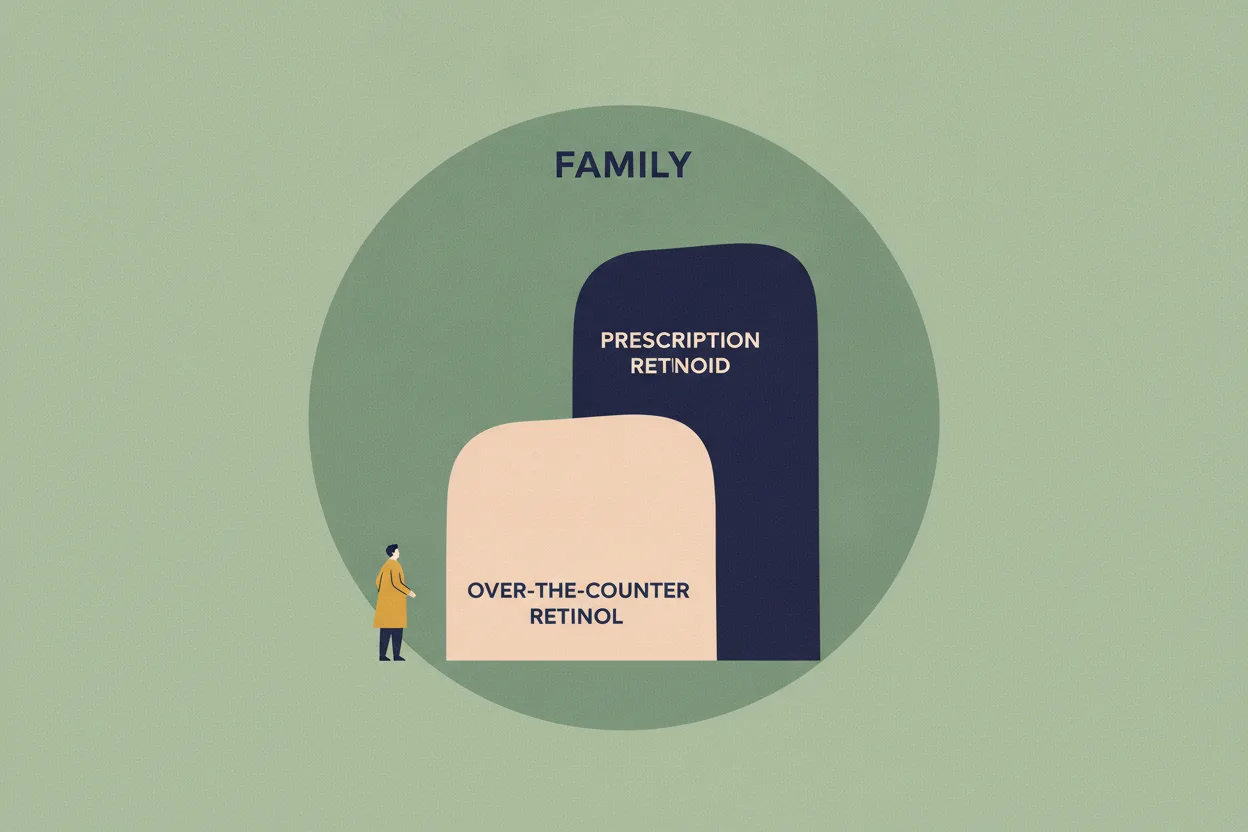
Retinol is one kind of retinoid, so the useful split is over-the-counter retinol versus prescription retinoids like tretinoin, which differ in strength and evidence.

By Artifact Editors, Editorial team
Published · 3 min read
In this article
Retinol is a retinoid, so the question is really strength
Retinoid is the umbrella term. It covers compounds derived from vitamin A or chemically or functionally similar to it, including natural forms like retinol, retinal and retinoic acid, plus synthetic analogues (Cleveland Clinic's retinol overview; a review of retinoids in skin treatments).
So the useful question is not whether retinol counts as a retinoid. It is how strong a given product is, and whether you can buy it without a prescription. For a broader primer, read our retinol guide.
Retinol is weaker because your skin has to convert it
Retinol is the weaker form because it must be converted inside the skin first. It becomes retinaldehyde, then retinoic acid, and only the final step is biologically active. That extra conversion is why retinol tends to act more slowly and irritate less (clinical evidence review).
- Activity ranking: retinyl esters, then retinol, then retinaldehyde, then retinoic acid.
- Tolerance runs in the opposite direction, so the weaker forms usually cause less irritation.
- Tretinoin is the prescription form most often used as the benchmark.
One review puts retinol at roughly tenfold less potency than tretinoin and cites 0.25% retinol as about as effective as 0.025% tretinoin, with less irritation. That is a secondary summary, and we did not verify it against the primary trials, so treat the exact ratio as a rough guide.
What the head-to-head trials show
Bottom line: in small trials, retinol and prescription retinoids often improve skin, and the clearest differences show up in speed and tolerability. The studies are short and small, so they cannot settle the question for everyone.
| Study | Size and length | Main finding |
|---|---|---|
| Retinol 0.25% to 1.0% vs tretinoin 0.025% to 0.1%, split face | 65 subjects, 12 weeks | Both arms improved significantly, with no significant difference in efficacy |
| Retinol vs retinoic acid, histology and gene expression | 4 weeks | Both raised epidermal thickness and collagen expression, with smaller effects from retinol |
| Oleyl adapalenate (adapinoid) 0.5% vs retinol 0.5% | Randomized head-to-head, 12 weeks | Wrinkle severity improved 9.45% vs 4.11%; adapinoid was better tolerated; pigment did not differ |
| Retinol vs retinoic acid as a chemical peel finish | 19 subjects, split face | No difference in efficacy or tolerability; authors had a commercial interest in the retinol product |
The adapinoid trial is the most interesting result, but adapinoid is a synthetic retinoid, not retinol, and it was compared against a single retinol concentration. The peel study is also small, and its authors had a commercial interest in the retinol product.
Prescription retinoids have the strongest acne evidence
Bottom line: for acne, the evidence favors prescription topical retinoids, and retinol is not on the list the guideline recommends. The American Academy of Dermatology acne guideline cites moderate-certainty evidence from 20 studies. Retinoids improved clearance versus vehicle at 12 weeks, with an IGA success risk ratio of 1.57 (95% CI 1.21 to 2.04) across four randomized trials (AAD acne guideline03389-3/fulltext)).
The guideline lists four FDA-approved topical retinoids for acne: tretinoin, adapalene, tazarotene and trifarotene. Adapalene 0.1% is available over the counter, and the other three need a prescription. Burning, dryness, redness and peeling limit tolerability for all of them.
What this means if you are choosing a product
Bottom line: retinol is a reasonable starting point for general texture and aging concerns, and it is the gentler choice. Expect slower results and do not read a weaker product as a safer one for every skin type. Irritation is still possible at any strength.
If your goal is acne, or you have had little luck with OTC products, a prescription retinoid has far more evidence behind it. Talk with a clinician before starting, especially if you are pregnant or planning to be. Retinol also breaks down in light and air, and we found no quantified comparison of how much that matters in real products.
Frequently asked questions
Is adapalene a retinol?
No. Adapalene is a synthetic retinoid, not retinol. The acne guideline we reviewed notes that adapalene 0.1% is sold over the counter, while other topical retinoids need a prescription.
Is tretinoin stronger than retinol?
Generally yes. One review cites a roughly tenfold potency difference, though that is a secondary summary. Tretinoin also tends to cause more irritation, and some small trials found similar results at the concentrations tested.
Do I need a prescription for retinoids?
Not always. Retinol and adapalene 0.1% are available over the counter. Tretinoin, tazarotene and trifarotene require a prescription in the sources we reviewed.
Sources (8)
- Cleveland Clinic — "Retinol: Cream, Serum, What It Is, Benefits, How To Use"
- Retinoids: active molecules influencing skin structure formation in cosmetic and dermatological treatments PMC6791161
- A Clinician's Guide to Topical Retinoids Motamedi et al., 2021, PMC8750127
- Guidelines of care for the management of acne vulgaris, JAAD fulltext
- Use of Retinoids in Topical Antiaging Treatments: A Focused Review of Clinical Evidence PMC9618501
- A comparative study of the effects of retinol and retinoic acid on histological, molecular, and clinical properties of human skin PubMed 26578346
- Prospective, double-blinded, randomized head-to-head trial of topical adapinoid oleyl adapalenate versus retinol PMC11608876
- Clinical efficacy comparison of retinol versus retinoic acid as the final step of a chemical peel procedure, JAAD