News
About 44% of drinkers who started a GLP-1 say they drank less, survey finds
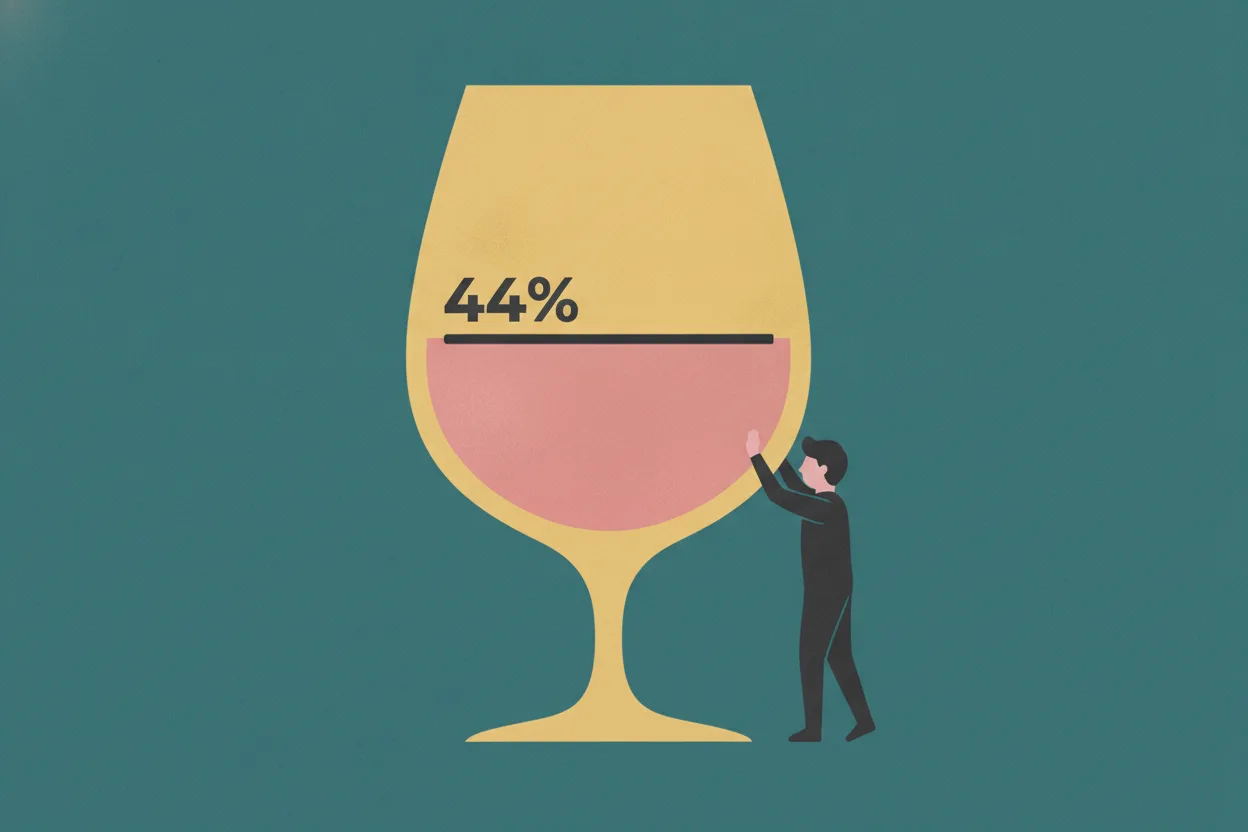
A JAMA Psychiatry research letter finds 44% of drinkers who took GLP-1 drugs say they drank less at first. It's self-reported, and it can't show the drugs caused the change.

By Artifact Editors, Editorial team
Published · 4 min read
In this article
What happened
About 44% of people who were drinking when they began a GLP-1 drug later said they drank less in the first three months. That comes from a survey published Oct. 14, 2026 as a JAMA Psychiatry research letter, as first reported by Medical Xpress.
Medical Xpress framed the result as an unexpected side effect. A JAMA news brief on the paper was more measured, saying the finding is consistent with earlier studies suggesting these drugs may reduce alcohol use (JAMA).
The headline number is real. It also describes a narrower group than the phrase "drinkers on GLP-1s" suggests, which we get to below.
What the survey found
Researchers led by Lori Uscher-Pines of Brown University used RAND's American Life Panel, a probability-based national sample of US adults. It was fielded in March and April 2026, and 2,009 of 2,857 invited panelists completed it, a 70.3% response rate (JAMA Psychiatry; PubMed).
Of those respondents, 368 (18.3%) said they currently or previously used a GLP-1 to lose weight or treat a chronic condition. Of those, 126 weren't drinking when they started and were excluded, which left 242 drinkers. Percentages below are survey-weighted; counts are unweighted.
| Group | Drank less | No change | Drank more |
|---|---|---|---|
| All 242 drinkers | 106 (44.2%) | 133 (52.6%) | 3 (3.3%) |
| 129 drinkers screening positive for unhealthy use | 71 (54.1%) | 55 (40.2%) | 3 (5.7%) |
Unhealthy drinking was flagged with the NIAAA single screening question, which asks about heavy-drinking days in the past year. One or more days counts as positive. After adjusting for sex, age, income, race/ethnicity and general health, a positive screen was associated with reporting a reduction (odds ratio 2.30, 95% CI 1.20 to 4.42). No demographic factor was.
Medical Xpress also reports that awareness of this effect among GLP-1 users was low. We couldn't confirm the exact figure, so we aren't quoting one.
What it does not show
It does not show that GLP-1s make people drink less. The authors list self-reported alcohol use, retrospective reporting of change, and possible recall and social-desirability bias as limits. They say large clinical trials are needed to draw conclusions.
- Nobody was compared with non-users, so we can't tell what drinking changes happen without the drug. Weight loss efforts alone can shift habits.
- The group includes former as well as current users, and it covers only the first three months, recalled later.
- The survey didn't measure how much people cut back, so "less" could mean a little or a lot.
- The "unhealthy use" flag looks at the past year, not the time of starting, and its bar is low: one heavy-drinking day.
- The at-risk subgroup is small (129 people), and the odds ratio's confidence interval is wide.
- It says nothing about whether these drugs work as a treatment for alcohol use disorder.
Also, "nearly half" fits only the whole group. The "about half" figure (54.1%) applies just to people screening positive for unhealthy drinking.
What it means for you
If you're on a GLP-1 and notice you're drinking less, you're not unusual in this sample. Roughly four in ten drinkers said the same. The survey did not measure whether the rest noticed any change.
If you're hoping a GLP-1 will fix your drinking, this survey doesn't support that plan. These drugs carry their own risks and indications, and the prescriber decision belongs with you and a clinician.
A more practical takeaway: tell your prescriber about your alcohol use, whether it goes up or down. If you're worried about your drinking, raise that directly. Treatments for alcohol use disorder already exist, and a clinician can help you sort out options.
How it fits with earlier research
Trials in people with alcohol use disorder are the stronger evidence, and they're still early. A phase 2 trial of 48 non-treatment-seeking adults with the disorder compared weekly semaglutide with placebo over 9 weeks. Its authors described it as initial prospective evidence for reduced craving and some drinking outcomes that justifies larger trials (Hendershot et al., JAMA Psychiatry 2025).
A systematic review reports that trial found fewer drinks per drinking day versus placebo (p = 0.04) and less total consumption and craving (each p = 0.01) (systematic review). A separate phase 2 trial of oral semaglutide in treatment-seeking adults reports reduced consumption, craving and alcohol-related problems (oral semaglutide trial).
A 2026 Lancet trial of semaglutide 2.4 mg weekly in people with alcohol use disorder and obesity also reports reduced drinking. Its authors note an earlier once-weekly exenatide trial found no overall effect on heavy drinking days. We haven't reviewed sample sizes or effect sizes for these two trials.
A review and meta-analysis in eClinicalMedicine00579-6/fulltext) concludes semaglutide and liraglutide appear most effective, but it pools randomized and observational evidence, and we haven't assessed its quality. A medRxiv preprint compares alcohol-related hospitalizations across drugs, though we haven't seen its results.
Frequently asked questions
Do GLP-1 drugs reduce drinking?
Some evidence points that way, including small trials in people with alcohol use disorder and a new self-report survey. The survey can't show cause and effect, and one earlier trial of a different GLP-1 drug, exenatide, found no overall effect on heavy drinking days.
Is 44% or 54% the right number?
Use 44.2% for all 242 people who were drinking when they started a GLP-1. The 54.1% figure applies only to the 129 who screened positive for unhealthy drinking.
Should I take a GLP-1 to cut back on alcohol?
This survey doesn't support that. It shows self-reported changes in people already taking the drugs for weight or a chronic condition. If you're concerned about your drinking, talk with a clinician about options.
Sources (11)
- Medical Xpress: About half of drinkers on GLP-1s say they imbibed less
- Patient-Reported Changes in Alcohol Use Following Glucagon-Like Peptide-1 Receptor Agonist Initiation Uscher-Pines et al., JAMA Psychiatry research letter, online Oct 14, 2026; doi:10.1001/jamapsychiatry.2026.3242; PMID 42873517
- PubMed record, same paper abstract and affiliations
- About half of drinkers on GLP-1s say they imbibed less Medical Xpress; read via search snippet only
- Survey Suggests GLP-1 Drugs May Curb Alcohol Use for Many Patients JAMA Medical News in Brief, Oct 30, 2026
- Once-Weekly Semaglutide in Adults With Alcohol Use Disorder: A Randomized Clinical Trial Hendershot et al., JAMA Psychiatry 2025; NCT05520775
- Glucagon-like Peptide-1 Receptor Agonists and Alcohol Use Outcomes: A Systematic Review of Clinical Evidence
- Oral semaglutide for Alcohol Use Disorder: A randomized clinical trial
- Once-weekly semaglutide versus placebo in patients with alcohol use disorder and comorbid obesity: a randomised, double-blind, placebo-controlled trial The Lancet, 2026
- Effects of glucagon-like peptide-1 receptor agonists on alcohol consumption: a systematic review and meta-analysis eClinicalMedicine
- GLP-1 Receptor Agonists vs Alternatives for Alcohol Use Disorder: A Multi-Target Trial Emulation medRxiv preprint
As first reported by Medical Xpress — read the original.