Retinol
Does retinol for the face actually work?
Retinol may ease fine lines a little, but the best trials are small and mixed. Here is what the studies show and where tretinoin stands.

By Artifact Editors, Editorial team
Published · 3 min read
In this article
The short answer: modest at best
Retinol can soften fine lines, but we would not promise a visible change from a drugstore serum. The strongest review we found, a systematic review of nine vehicle-controlled trials of over-the-counter products, found four with no significant difference from vehicle. The other five showed weak evidence of a mild effect on fine lines, but the authors judged them to have major methodological flaws (systematic review of over-the-counter vitamin A cosmetics).
The authors concluded there is very little, if any, trustworthy evidence that over-the-counter retinol products improve aged skin. That is a strong statement, and it applies to the products on store shelves, not to every retinol formula ever tested.
What the trials that found an effect looked like
The most encouraging study is an older randomized trial in naturally aged skin. Retinol 0.4% significantly reduced fine wrinkling compared with vehicle in 36 participants, and fine wrinkles began to ease at week 4 and kept improving through week 24 (JAMA Dermatology trial on vitamin A in aged skin). That is a clear signal, but the sample is small and the study is dated.
A focused review lists retinol strengths from 0.075% to 0.5% across studies. In a 12-week split-face trial of 65 subjects, retinol at 0.25%, 0.5%, and 1.0% each improved photodamage, with no significant difference between strengths. That was a secondary summary, so we did not check the primary paper (focused review of topical retinoids).
How retinol compares with tretinoin and other options
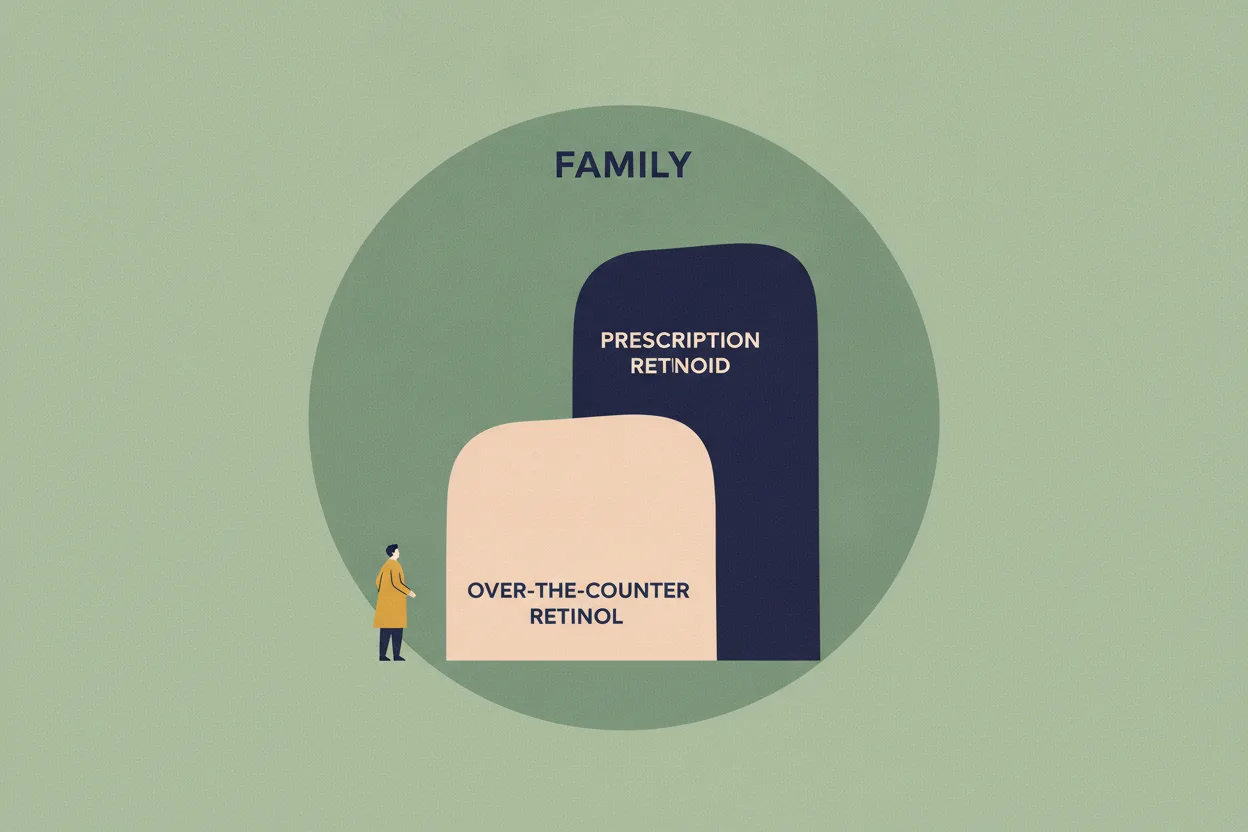
Prescription tretinoin has much better data. A meta-analysis of randomized trials found significant improvements in both fine wrinkles and coarse wrinkles (meta-analysis of tretinoin for photodamaged skin). Those are tretinoin numbers, not retinol numbers, but they show the bar retinol has not yet been shown to clear.
In a 12-week head-to-head trial of 48 people, oleyl adapalenate 0.5% improved wrinkle severity by 9.45%, while retinol 0.5% improved it by 4.11% compared with baseline. The retinol arm had no placebo, so that figure only shows a modest change over time. Oleyl adapalenate was also better tolerated at every follow-up (head-to-head trial of adapalene and retinol).
A trial of a non-prescription tri-retinol 1.1% against tretinoin 0.025% found both products improved signs of photodamage, but only 34 subjects completed it. Tri-retinol is a blend rather than pure retinol, so the result does not transfer directly (tri-retinol versus tretinoin trial).
A peptide serum trial over 56 days found retinol 0.002% reduced crow's-feet area, but the peptide did more. The source reads like a manufacturer-style comparison, so we treat it as preliminary (peptide versus retinol trial).
Irritation, approvals, and what we could not verify
Tolerability is the practical trade-off. In the head-to-head trial, the alternative was easier on skin than retinol. Stronger prescription retinoids can be harsher still: in one acne review, tretinoin 0.05% caused adverse events in 62% of patients, versus 19% for adapalene 0.1%. That was an acne population, so it is context, not a retinol figure (JAAD review of retinoids in aging skin).
The only topical the FDA has approved for fine lines, mottling, and roughness from aging and sun exposure is tretinoin, not retinol. That same review is from 1998, so treat its regulatory details as dated.
How we would approach retinol if you try it
If you want to test it, start low and slow: a few nights a week, a moisturizer, and sunscreen in the morning. The best trial signal showed up around week 4 and kept building to week 24, so a 12-week trial is a fair minimum before you judge. Stop if you notice burning or persistent peeling. For a fuller breakdown of the ingredient, see our retinol topic page.
Frequently asked questions
Does retinol for the face work at all?
Possibly, and modestly. The best systematic review found little trustworthy evidence for over-the-counter products, while one older trial showed a clear reduction in fine wrinkles. Expect a subtle change at most.
How long does retinol take to show results?
The one placebo-controlled trial we found saw fine wrinkles begin to ease at week 4, with improvement through week 24. Most other trials ran 8 to 24 weeks, so a 12-week window is a reasonable minimum to judge.
Is retinol as strong as tretinoin?
Not on current evidence. Tretinoin is FDA-approved for aging signs and has meta-analysis data showing significant wrinkle improvement. Retinol has not been shown to match that effect size in trials, though the comparisons are limited.
Sources (8)
- Evidence for the Efficacy of Over-the-counter Vitamin A Cosmetic Products in the Improvement of Facial Skin Aging: A Systematic Review
- Use of Retinoids in Topical Antiaging Treatments: A Focused Review of Clinical Evidence for Conventional and Nanoformulations
- Improvement of Naturally Aged Skin With Vitamin A Retinol — JAMA Dermatology
- A prospective, double-blinded, randomized head-to-head clinical trial of topical adapinoid oleyl adapalenate versus retinol
- A randomized, double-blind, controlled comparative trial of the anti-aging properties of non-prescription tri-retinol 1.1% vs. prescription tretinoin 0.025%
- Tretinoin for Photodamaged Facial Skin: Systematic Review and Meta-Analysis of Randomized Controlled Trials
- Novel Cyclized Hexapeptide-9 Outperforms Retinol Against Skin Aging: A Randomized, Double-Blinded, Active- and Vehicle-Controlled Clinical Trial
- A practical approach to the use of retinoids in aging skin — Journal of the American Academy of Dermatology