Retinol
Retinol versus retinoid: what's the difference?
Retinol is one over-the-counter member of the retinoid family, weaker than prescription tretinoin, and the head-to-head trials comparing them are small.

By Artifact Editors, Editorial team
Published · 3 min read
In this article
Retinoid is the category, retinol is one member
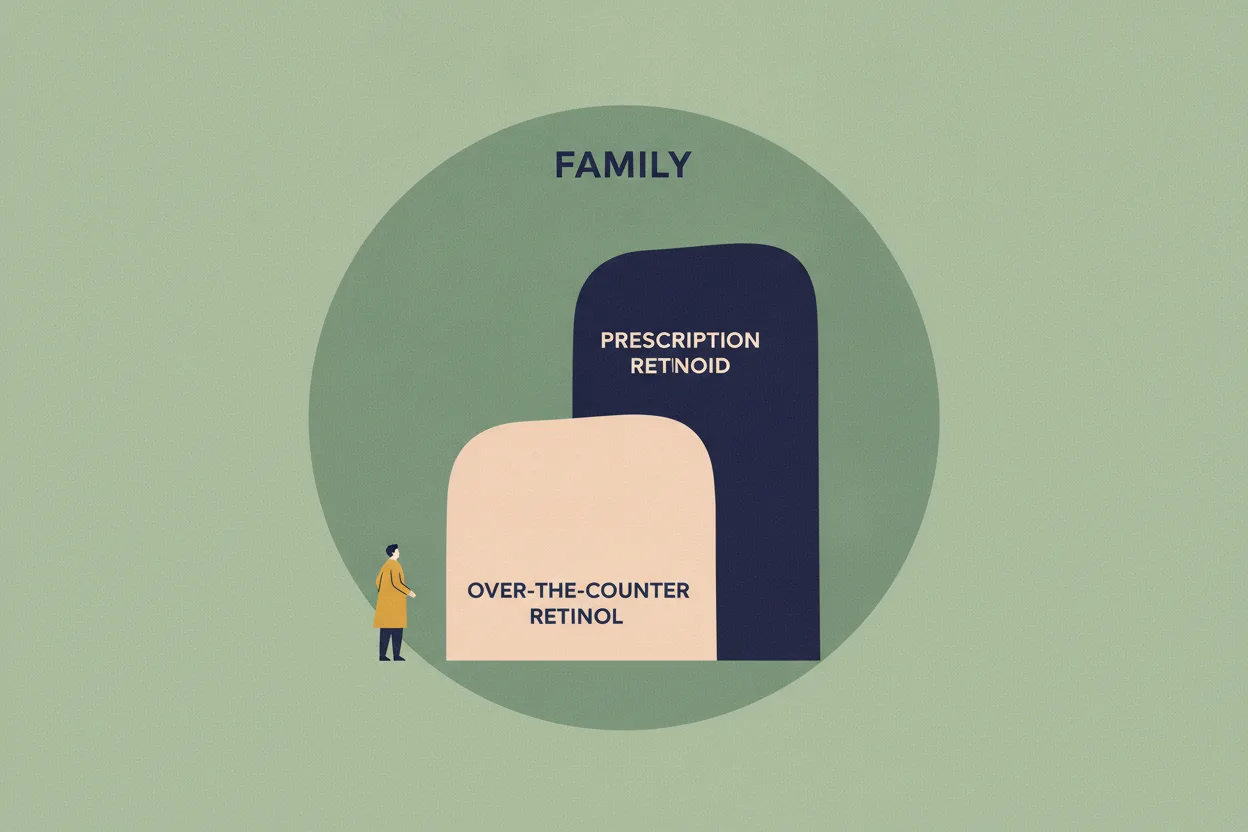
Bottom line: comparing retinol with retinoid is comparing a family with one of its members. Retinoid is the umbrella term for natural and synthetic analogues of vitamin A, plus compounds that are structurally or functionally similar to it.
Retinol is a first-generation member of that group. Your skin converts it to retinoic acid through a two-step oxidation, and that conversion path is one reason its strength differs from prescription options (the retinoid overview). For a broader primer on the ingredient, see our retinol guide.
Potency and prescription status are the real differences
Bottom line: prescription tretinoin is stronger, and retinol needs a higher concentration to approach it. The exact multiplier depends on which review you read.
A focused review of topical antiaging retinoids calls retinol about tenfold less potent than tretinoin. It gives a rough equivalence of 0.25% retinol to 0.025% tretinoin, but this is a narrative review, so treat that as a heuristic rather than a measured result.
Other sources disagree. One review puts retinoic acid at about 20 times the power of retinol, and a clinician's guide to topical retinoids says the final active form can be hundreds of times more potent than cosmetic retinol or retinaldehyde. We would not quote a single multiplier as settled.
| Feature | Retinol (OTC) | Tretinoin (Rx) |
|---|---|---|
| Prescription needed | No | Yes |
| Relative potency | Weaker; roughly tenfold per one review | Stronger |
| Rough equivalence | 0.25% retinol is about 0.025% tretinoin (heuristic) | Reference point |
| Irritation | Generally milder | Generally stronger |
What the head-to-head trials actually show
Bottom line: in small trials, retinol-equivalent formulas and tretinoin look similar on efficacy. The evidence is thin and often tied to the sponsor.
In a 12-week split-face trial published in JAAD, three sustained-release retinol strengths (0.25%, 0.5%, and 1.0%) were compared with tretinoin at 0.025%, 0.05%, and 0.1%. Both arms improved significantly from baseline on every measure, and we found no significant difference between them. The review summarizing it lists 65 subjects.
A second JAAD split-face trial tested a non-prescription tri-retinol 1.1% product against tretinoin 0.025%. Only 34 subjects finished (16 on tri-retinol, 18 on tretinoin). Efficacy did not differ significantly, and adverse effects were mild or less. The test product was made by SkinMedica, so read that result with the sponsor relationship in mind.
A 48-woman, 12-week three-arm trial compared a double-conjugated retinoid cream with 1.0% retinol and 0.025% tretinoin. The new cream was noninferior to tretinoin at 4 and 8 weeks and caused less erythema than retinol. That product is not a standard retinol, so it doesn't answer the OTC question.
We did not find an independent, adequately powered trial of standard OTC retinol at 0.5% or 1% against tretinoin. Most comparisons use branded or sustained-release formulas.
What to expect and how to choose
Bottom line: if you use OTC retinol, be patient and expect smaller changes. Harvard Health says wrinkle improvements take three to six months of regular use to show.
Harvard Health says OTC retinol is less effective than tretinoin at reducing wrinkles, but it does improve the appearance of photoaged skin. The lower strength is also why it irritates less. A review of concentration effects found lower concentrations gave less pronounced improvement, with fewer adverse effects than higher ones.
- Start with a lower concentration and build up slowly.
- Judge results after three to six months, not three weeks.
- If OTC retinol hasn't moved the needle, ask a dermatologist whether prescription tretinoin makes sense.
Frequently asked questions
Is retinol the same as retinoid?
No. Retinoid is the broad class of vitamin A-derived compounds, and retinol is one member, sold over the counter. Prescription tretinoin is another member. The differences you'll notice mostly come from potency and whether you need a prescription.
Does retinol work as well as tretinoin?
Small trials mostly found comparable efficacy between retinol-equivalent formulas and tretinoin. But these trials were short, often sponsor-linked, and rarely tested standard OTC retinol. Tretinoin is the more potent option, and it tends to irritate more.
How long does retinol take to work?
Harvard Health reports that wrinkle improvements usually take three to six months of regular use. Be wary of any brand promising faster results without trial data behind the claim.
Sources (11)
- Retinoids: active molecules influencing skin structure formation in cosmetic and dermatological treatments
- Retinoids: active molecules influencing skin structure formation same as 1; see the potency note above
- Use of Retinoids in Topical Antiaging Treatments: A Focused Review of Clinical Evidence for Conventional and Nanoformulations
- A Clinician's Guide to Topical Retinoids
- Use of Retinoids in Topical Antiaging Treatments see 3; potency equivalence section
- A randomized, double-blind, split-face comparative study of a novel irritation-control retinol formulation versus tretinoin in photodamaged skin — JAAD
- A randomized, double-blind, controlled comparative study of a novel non-prescription tri-retinol 1.1% product vs prescription tretinoin 0.025% in photodamaged skin — JAAD
- Efficacy and tolerability of a double-conjugated retinoid cream vs 1.0% retinol cream or 0.025% tretinoin cream in subjects with mild to severe photoaging — PubMed
- Do retinoids really reduce wrinkles? — Harvard Health
- Retinoid or retinol? — American Academy of Dermatology consumer page
- Retinoids in the treatment of skin aging: an overview of clinical efficacy and safety