Retinol
Can you use retinol with vitamin C together?
You can use them together, but the research does not yet show the pair works better than either one alone.

By Artifact Editors, Editorial team
Published · 3 min read
In this article
The bottom line on combining them
Using retinol and vitamin C in one routine is not known to be harmful for most people, but the evidence that they enhance each other is thin. We found no randomized trial that tested a combined product against each ingredient alone with a control arm.
Most of what exists is small, short, or run by the companies that make the products. That does not make the idea wrong. It means the synergy claim is a hypothesis, not a finding.
What the combination studies found
The oldest data come from two vehicle-controlled studies in postmenopausal women, summarized in a 2009 review of vitamins and photoaging00959-1/abstract) and an overview of retinoids for skin aging. One arm had only 8 volunteers, and the authors said the combination could partly reverse photoaging. That is a suggestion from a tiny sample, not a result you can plan around.
A more recent open-label trial gave 44 women a retinol treatment and a separate vitamin C moisturizer for 12 weeks. Most measures improved by week 4, and results were statistically significant at weeks 8 and 12. Dryness rose at weeks 4 and 8. With no control arm, you cannot tell how much of that was the regimen itself.
A Japanese bi-phase serum study02345-4/fulltext) kept retinol and vitamin C apart until mixed, which matters because both break down easily. In 14 women over 12 weeks, instrumental measures showed gains in elasticity, hydration, and dermal collagen. It was single-arm and small, so treat the percentages as descriptive. A Shanghai study of 120 women reported a favorable vitamin C to retinyl ester ratio in lab tests, but the clinical effect sizes were not in the text we could retrieve.
Vitamin C and retinol on their own
If you want to know whether either ingredient does something useful alone, the evidence is better. In a half-face trial03037-4/abstract) of 55 women, 10.5% vitamin C and 0.075% retinol each improved texture, tone, and fine lines over 12 weeks. Vitamin C did better on marionette lines and overall tone, while retinol did better on mottled and discrete pigmentation.
A 2023 systematic review of seven RCTs with 139 volunteers found topical vitamin C made treated skin look smoother and less wrinkled, with biopsy support. That is a useful signal, but it covers vitamin C alone. For background on how retinol works and what it can irritate, see our retinol guide.
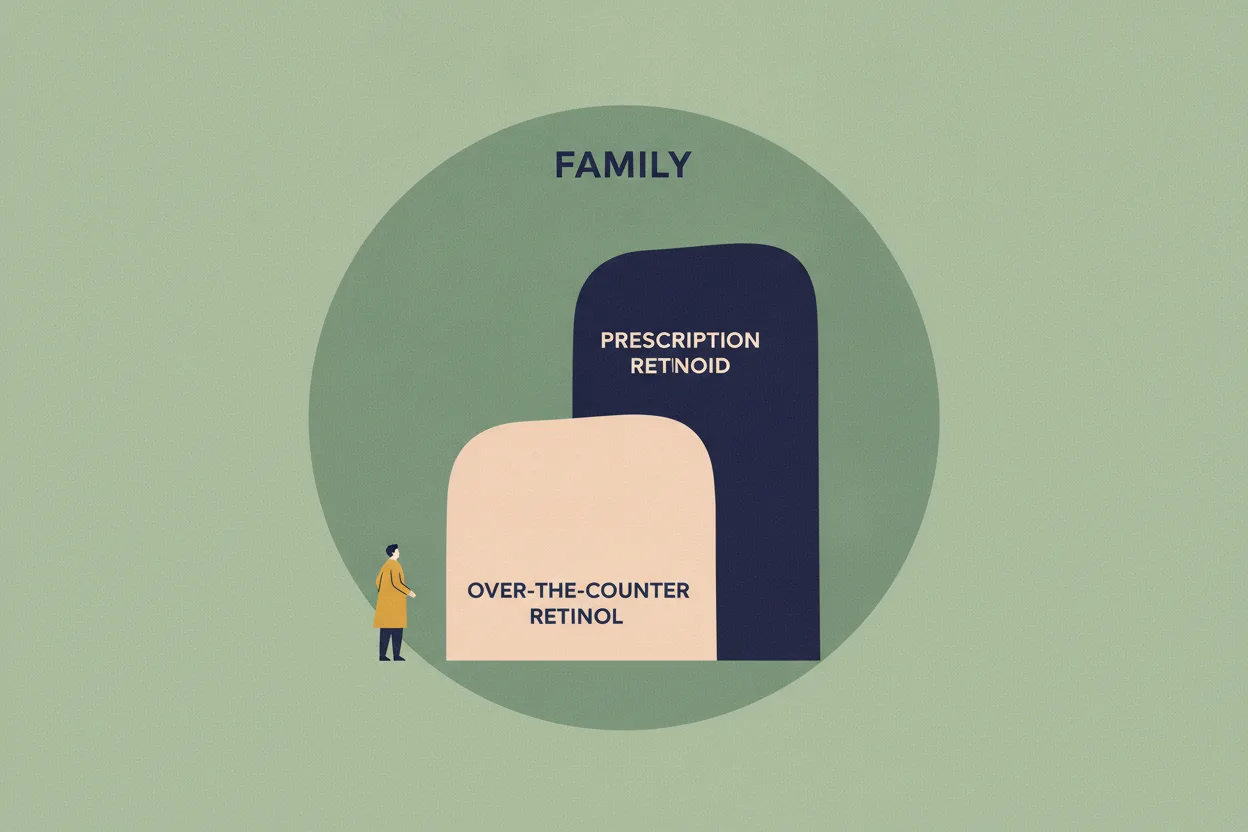
Not all retinol is equal. A 48-week trial of retinyl propionate found no significant benefit over placebo, which is a reminder that retinol esters are weaker than retinoic acid. A head-to-head trial of 48 people found a newer retinoid, oleyl adapalenate, beat retinol on wrinkles and caused less irritation over 12 weeks.
How to use them without irritating your skin
The safest bet is to separate them. Cleveland Clinic guidance suggests vitamin C in the morning and retinol at night, and introducing one product at a time over a couple of weeks. That advice is consumer guidance rather than a trial, but it is sensible for anyone with sensitive skin.
Frequently asked questions
Can you put vitamin C and retinol on at the same time?
Some people do, and no study we found shows it is dangerous. However, we found no formal safety study of applying them together, and the common advice is to separate them. If your skin is sensitive, staggering them lowers the odds of irritation.
Does vitamin C make retinol work better?
The evidence does not show that yet. The studies we found tested combined products or compared the two ingredients separately, but none tested a combination against each ingredient alone with a control arm.
Which should I start with if I am new to both?
Start with one at a time, usually vitamin C in the morning, and wait a couple of weeks before adding retinol at night. Retinol is more likely to dry or irritate, so a lower strength is a reasonable place to begin.
Sources (9)
- An Open Label Clinical Trial to Evaluate the Efficacy and Tolerance of a Retinol and Vitamin C Facial Regimen in Women With Mild-to-Moderate Hyperpigmentation and Photodamaged Facial Skin — PubMed
- Retinoids in the treatment of skin aging: an overview of clinical efficacy and safety — PMC
- Vitamins and photoaging: Do scientific data support their use? — JAAD
- Clinical evaluation of the efficacy of vitamin C compared to retinol treatment in subjects with moderate photo damage — JAAD
- The Efficacy Assessment of a Bi-Phase Serum Containing Vitamin C Derivatives and Retinol in Aged Skin — JAAD
- A Functional Skincare Formulation Mixed With Retinyl Propionate, Hydroxypinacolone Retinoate, and Vitamin C on Antiaging and Whitening Han Women in Shanghai, China — PMC
- Efficacy of topical vitamin C in melasma and photoaging: A systematic review — PubMed
- A prospective, double-blinded, randomized head-to-head clinical trial of topical adapinoid oleyl adapalenate versus retinol — PMC
- Retinol: Cream, Serum, What It Is, Benefits, How To Use — Cleveland Clinic